

System Integrity · Digital Immunity
Network Integrity &
Immunity System
A structural immunity layer designed to preserve the stability of machines and networks supporting public digital infrastructure.
MACHINE WORLD · IMMUNITY ARCHITECTURE · CONTINUITY FIRST
Infrastructure Risk Environment
Systemic digital risk in interconnected environments
Digital infrastructure now underpins education systems, justice institutions, healthcare environments, financial networks, and public administration worldwide. As connectivity expands and automation accelerates, these systems no longer operate as isolated tools. They function as tightly coupled, interdependent networks where failure in one domain can propagate across many others.
Global infrastructure research consistently identifies three structural conditions shaping modern digital risk: expanding exposure surfaces, rapid cross-network propagation, and increasing execution velocity driven by automation. Devices, services, and control layers interact continuously, creating environments where disruption can scale faster than traditional response cycles.
In highly networked systems, incidents are rarely contained to a single component. Faults, misconfigurations, malicious activity, or cascading software failures can traverse routing layers, cloud environments, edge devices, and institutional platforms within minutes. As systems integrate machine learning, autonomous processes, and real-time orchestration, operational decisions may execute at machine speed, compressing the window for human intervention.
Conventional security models remain essential but are largely reactive: detect, analyze, respond, recover. In public infrastructure environments that cannot simply reset or pause without consequence, post-incident recovery alone is insufficient. Stability must be embedded architecturally, not appended as an afterthought.
Contemporary resilience frameworks increasingly emphasize containment, bounded execution, structural separation, and continuity planning as primary safeguards. Systems are expected to anticipate deviation, localize disruption, preserve escalation pathways, and maintain operational clarity under stress.
The diagram below illustrates how interconnected digital infrastructure allows disruption to propagate across domains. Failures originating in one operational environment may cascade through shared networks, services, and control layers, affecting institutions that depend on continuous digital operation.
View interconnected infrastructure risk model
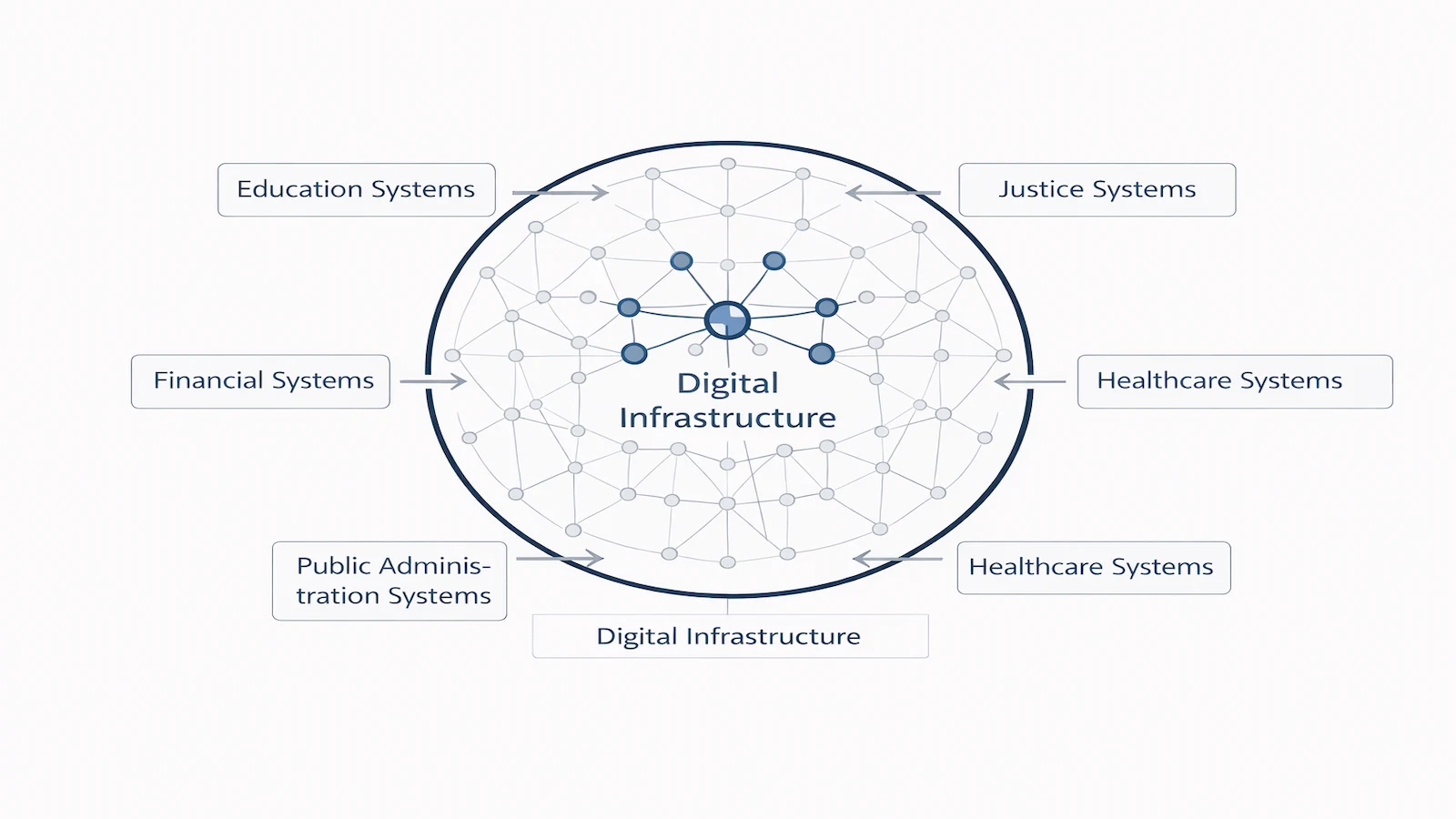
Modern digital infrastructure forms a tightly connected operational environment. Failures, attacks, or software faults originating in one domain can propagate across shared networks and platforms, creating cascading disruptions that affect multiple public systems.
NIIS emerges from these documented conditions. It does not attempt to eliminate risk through centralized authority or adaptive autonomy. Instead, it establishes a structural digital immunity layer — maintaining containment, preserving machine-level integrity, and ensuring that execution remains bounded even as scale and complexity grow.
Digital Immunity
Stability for the machine world
The Network Integrity & Immunity System (NIIS) forms the immunity layer within the ARMI architecture. It operates across machines and networks to preserve structural stability, continuity, and predictable behavior in complex digital environments.
As public infrastructure becomes increasingly dependent on interconnected devices, distributed systems, and autonomous processes, resilience can no longer rely on reactive security models. Immunity must be embedded directly into system structure.
NIIS approaches protection as a continuous condition rather than an event. It evaluates machine states, network behavior, and operational integrity in real time, coordinating bounded responses that preserve continuity without disrupting institutional control.
Within ARMI’s dual-world model, NIIS safeguards the machine environment, enabling civic intelligence systems to operate above a stable and dependable digital foundation.
Architectural Position
The immunity layer within ARMI
Within the broader ARMI framework, this immunity layer occupies a defined architectural position between intelligence mediation and execution control systems.
NIIS occupies the machine-facing domain of the ARMI canonical architecture. It is positioned between execution systems and the intelligence layers that govern institutional reasoning.
Above NIIS, the Central Intelligence Interface (CII) mediates structured communication with NAVI, ensuring that civic intelligence and machine immunity remain distinct yet interoperable.
Below NIIS, two execution domains operate: the Machine Control System (MCS) and the Network Control System (NCS). These systems enforce containment and stabilization directives within their respective environments.
Information flows upward in summarized form for oversight, while bounded directives flow downward for execution. This directional structure preserves clarity across layers and maintains predictable system behavior as complexity scales.
View NIIS architectural position
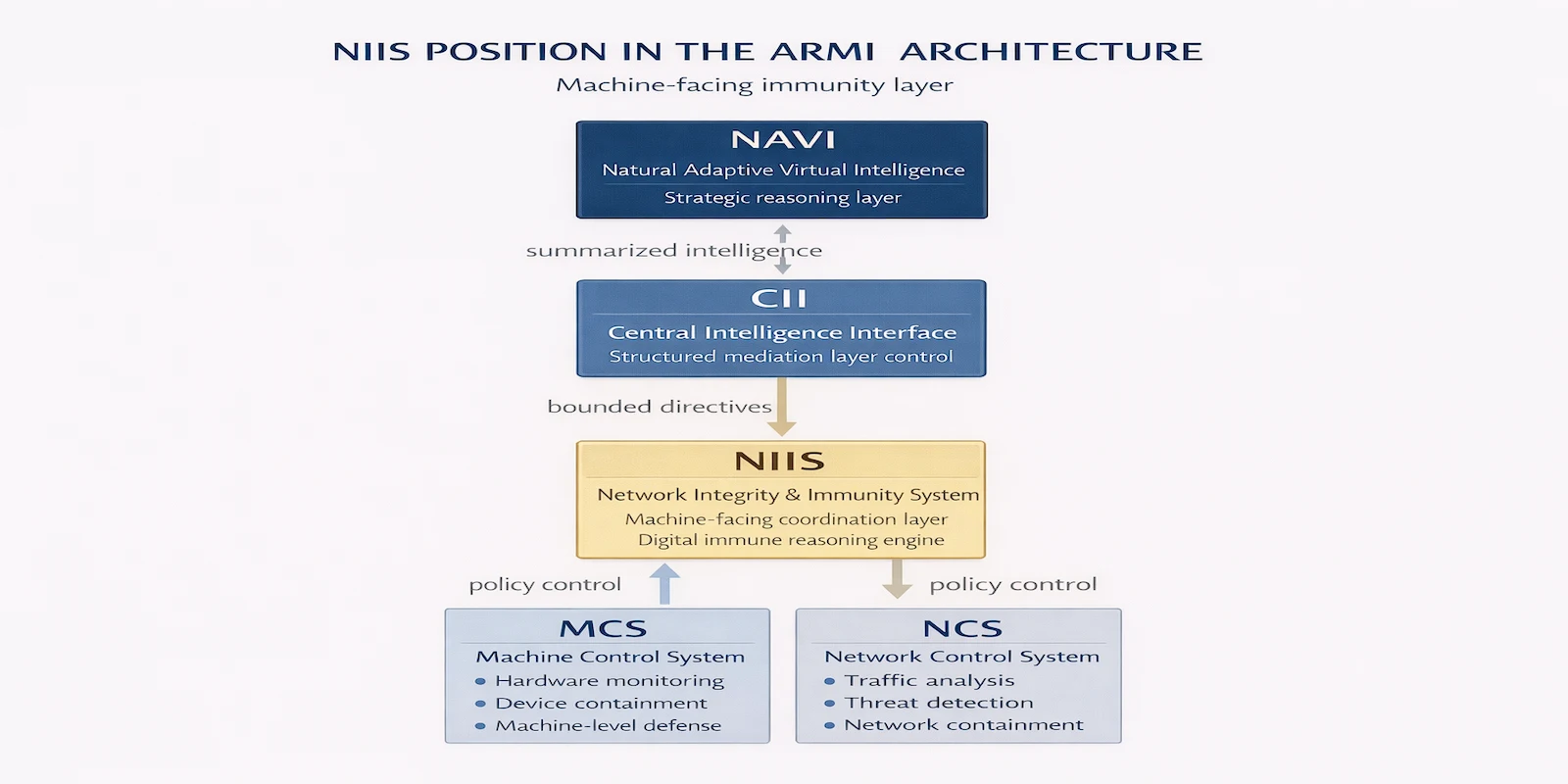
NIIS positioned within the machine-facing domain, mediating between intelligence layers (CII and NAVI) and execution systems (MCS and NCS), preserving separation between reasoning and deterministic control.
Immunity Model
Observation, deviation, and continuity
NIIS approaches protection as a continuous evaluation of machine and network behavior. Rather than focusing on isolated events, it maintains a structural understanding of operational baselines across devices, processes, and traffic flows.
The first stage is observation. Machine telemetry and network signals are normalized and contextualized through the Machine Control System (MCS) and the Network Control System (NCS), forming a consistent view of system state.
The second stage evaluates deviation. Patterns that diverge from established operational norms are assessed in relation to system stability, scope, and continuity requirements.
When stabilization is required, NIIS coordinates bounded containment through its execution layers. Actions remain proportional, localized, and reversible, preserving the integrity of the broader environment.
This model enables systems to adapt to change while remaining structurally coherent. Immunity is not an external add-on, but an embedded architectural condition that supports long- horizon reliability.
View immunity evaluation model
Execution Domains
Coordinated control across machines and networks
NIIS operates through two execution domains: the Machine Control System (MCS) and the Network Control System (NCS). Together, these systems translate immunity directives into controlled actions within physical and virtual environments.
The Machine Control System focuses on device-level integrity. It evaluates hardware telemetry, operating system signals, firmware states, and process behavior, ensuring that individual machines remain stable and consistent with defined baselines.
The Network Control System operates across routing layers, traffic flows, and inter-device communication patterns. It preserves structural coherence within distributed environments and maintains predictable network behavior.
NIIS coordinates these domains through bounded directives. Execution remains localized within MCS and NCS, while cross-domain correlation and stabilization logic remain centralized within the immunity layer.
The diagram below illustrates how NIIS coordinates stabilization across machine and network domains. While evaluation and correlation occur within the immunity layer, execution remains distributed through dedicated control systems responsible for devices and network infrastructure.
View execution domain structure
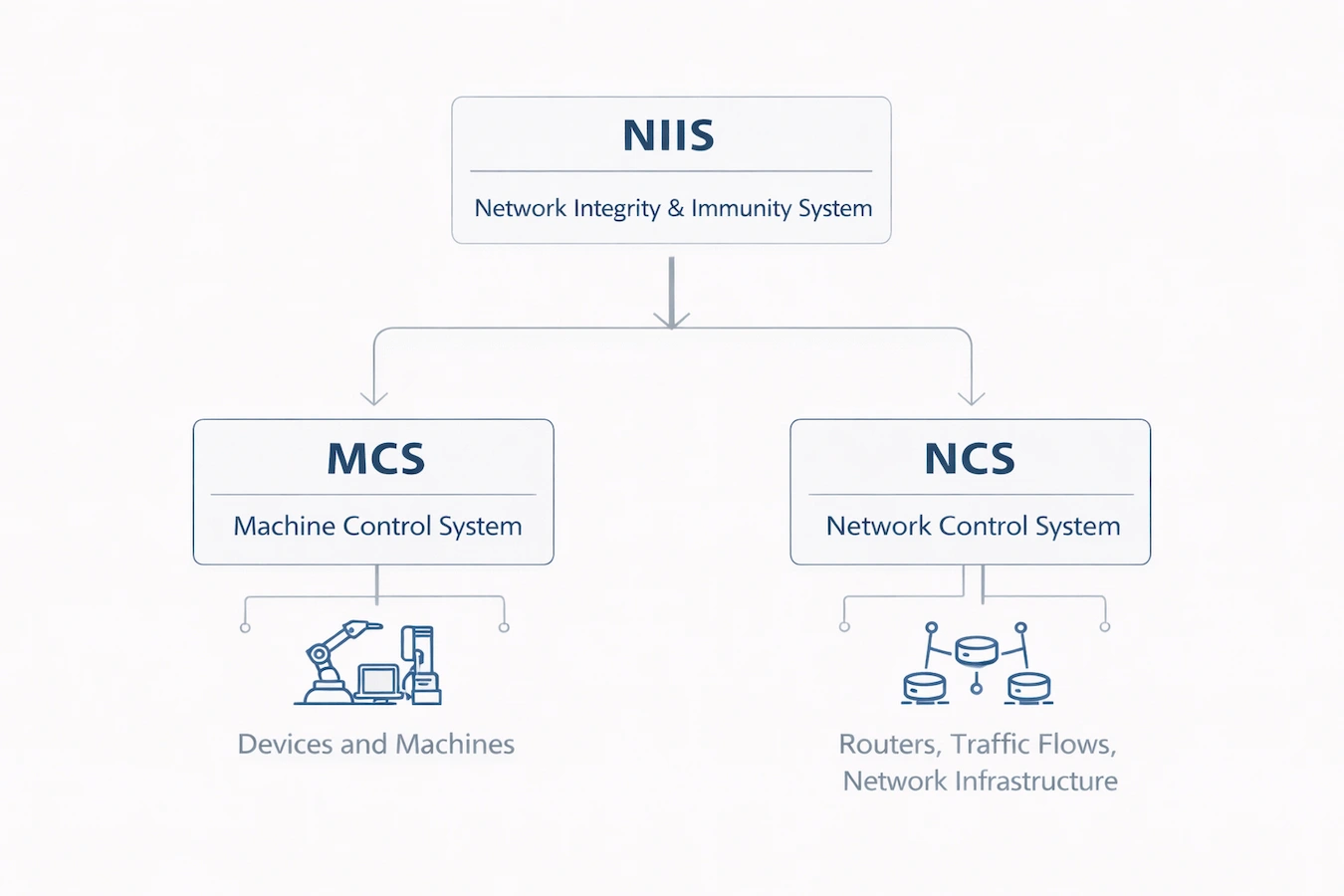
NIIS coordinates stabilization across two execution domains. The Machine Control System (MCS) maintains device-level integrity, while the Network Control System (NCS) preserves structural coherence across routing layers and communication flows. Execution remains distributed while coordination remains centralized within the immunity layer.
This separation ensures that evaluation, coordination, and execution remain structurally distinct. As systems scale, clarity across these layers preserves continuity without concentrating control within a single component.
Dual-World Architecture
Separation between civic intelligence and machine immunity
While the previous section describes how NIIS coordinates stabilization across machine and network execution domains, these control systems exist within a broader architectural separation that defines how the ARMI framework operates. Execution stability and civic intelligence function in different operational worlds, each governed by distinct responsibilities and structural boundaries.
ARMI is structured around two distinct operational domains: the civic world and the machine world. Each domain serves a different purpose and operates through separate layers of intelligence and control.
The civic domain, accessed through the Intelligent Civic Interface (ICI) and guided by NAVI, supports education, justice, and institutional reasoning. It engages with human meaning, interpretation, and public service delivery.
The machine domain, governed by NIIS, maintains the integrity of devices, networks, and execution systems. It evaluates operational states, coordinates containment when required, and preserves structural continuity across digital environments.
These domains cooperate through structured interfaces while remaining architecturally distinct. Civic intelligence operates above a stable technical foundation, and machine immunity functions independently from human-facing processes.
The diagram below illustrates this dual-world architecture. Civic intelligence systems operate within the human-facing domain, while NIIS maintains stability within the machine infrastructure layer. Interaction occurs through defined architectural boundaries that preserve separation between interpretation and execution.
View dual-world architecture model
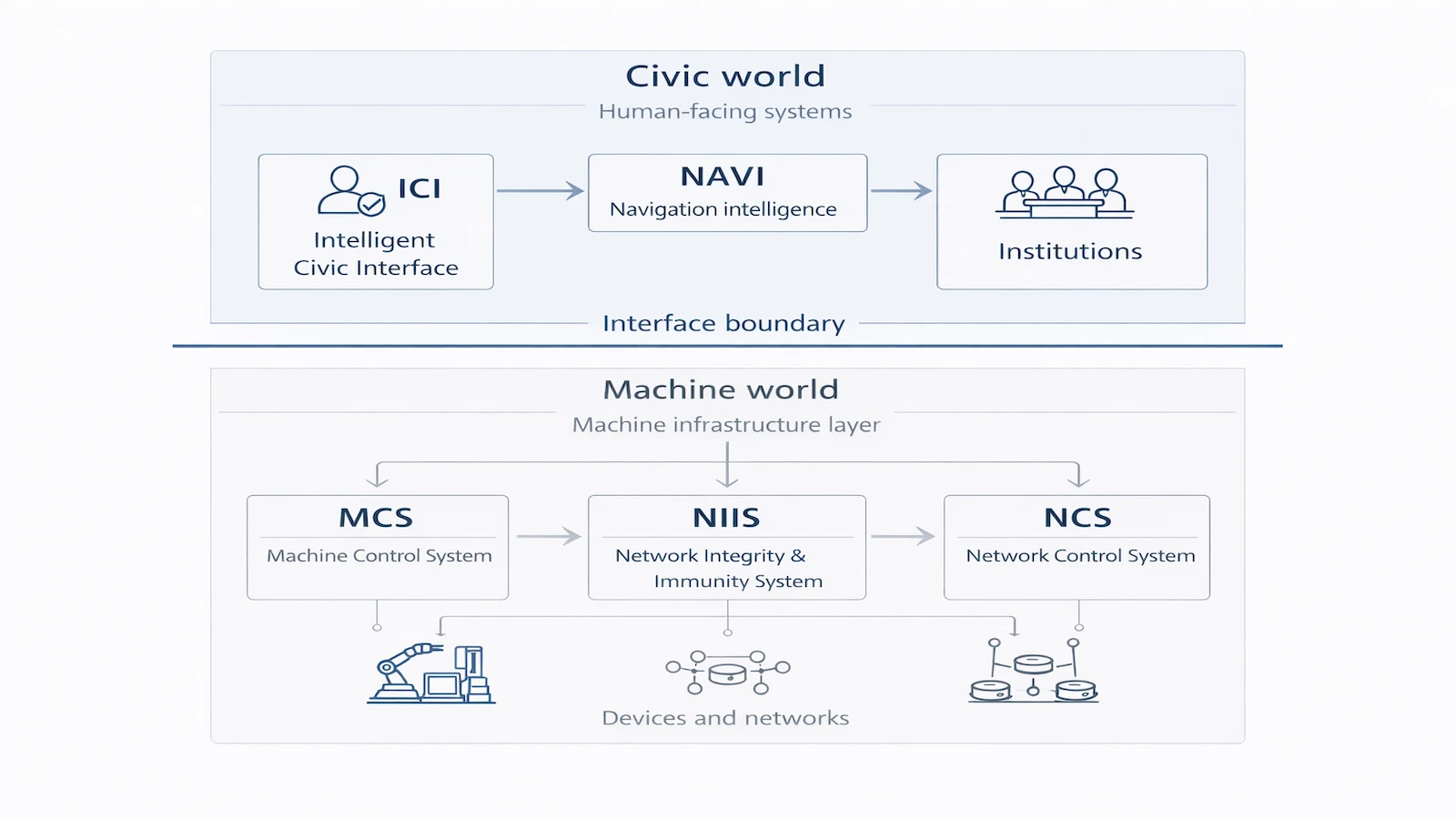
ARMI separates civic intelligence from machine infrastructure. Human-facing systems such as ICI and NAVI operate within the civic domain, while NIIS safeguards devices, networks, and execution systems in the machine domain. Structured interfaces maintain cooperation without collapsing these responsibilities into a single operational layer.
This separation preserves clarity of purpose across the architecture. Intelligence focused on public outcomes remains insulated from execution control, while infrastructure stability remains consistent regardless of civic context.
Continuity
Designed for long-horizon operational stability
The layered design described above allows NIIS to maintain operational stability even as the surrounding infrastructure evolves.
NIIS is structured for environments that evolve over time. Devices are replaced, networks expand, software layers change, and institutional contexts shift. The immunity layer maintains coherence across these transitions by preserving structural baselines rather than static rules.
As systems scale geographically and computationally, complexity increases. NIIS absorbs that complexity through layered mediation and bounded coordination, preventing drift across execution domains.
Stability does not require rigidity. The architecture allows controlled adaptation while maintaining interpretability. Operational states remain observable, deviations remain classifiable, and corrective actions remain proportionate.
This approach supports institutions that depend on infrastructure across decades. Immunity is not tied to a specific deployment scale or technological generation; it is embedded as a structural principle that endures through change.
In this sense, NIIS functions as continuity infrastructure — preserving clarity, reliability, and bounded behavior wherever machine systems operate within the ARMI framework.
System Integrity
Continue through the Integrity Layers
The systems below form the machine and infrastructure integrity layers of the ARMI architecture. They operate beneath civic interfaces to preserve execution boundaries, maintain operational stability, and ensure that technical systems remain constrained by institutional governance.
Each layer performs a distinct role within the integrity stack. Explore adjacent components of the architecture below.

NAVI
Situational synthesis and advisory reasoning.
LEARN MORE →
NIIS
Infrastructure immunity and systemic safety constraints.
LEARN MORE →
MCS
Deterministic machine execution governance.
LEARN MORE →
NCS
Network routing boundaries and isolation control.
LEARN MORE →
Guardian Switch
Sovereign isolation hard-stop for exceptional conditions.
LEARN MORE →
Kernel
Deterministic execution substrate with capability boundaries.
LEARN MORE →Closing
Structural immunity within public infrastructure
NIIS operates as the immunity layer within ARMI’s canonical architecture. It maintains coherence across machine and network domains while preserving separation from civic intelligence and institutional reasoning layers.
By coordinating execution systems through bounded directives and layered mediation, NIIS supports infrastructure that remains stable, interpretable, and durable across changing technical environments.
As part of the broader System Integrity framework, NIIS contributes to a structural model in which capability may scale without collapsing architectural clarity.
Documentation
Technical papers and research
NIIS is supported by structured technical documentation, architectural whitepapers, and ongoing research materials describing its immunity model, governance alignment, and integration framework.