

Overview
Governed network execution
The Network Control System (NCS) is the execution governance layer for networks operating as public and institutional infrastructure within DIPA (Digital Infrastructure for Public Access). It exists because network behavior at civic scale cannot remain dependent on ad-hoc intervention, discretionary tooling, or informal operational control.
NCS does not define policy, interpret intent, or optimize outcomes. Its function is structural: ensuring that execution remains bounded inside explicitly authorized constraints established through institutional governance and integrity architecture.
At large scale, networks do not merely transmit traffic — they mediate access, continuity, and operational stability across education systems, justice environments, medical infrastructure, and critical public services. In such conditions, execution must remain predictable, reviewable, and subordinate to human authority rather than emergent from complexity.
View Network Infrastructure Diagram
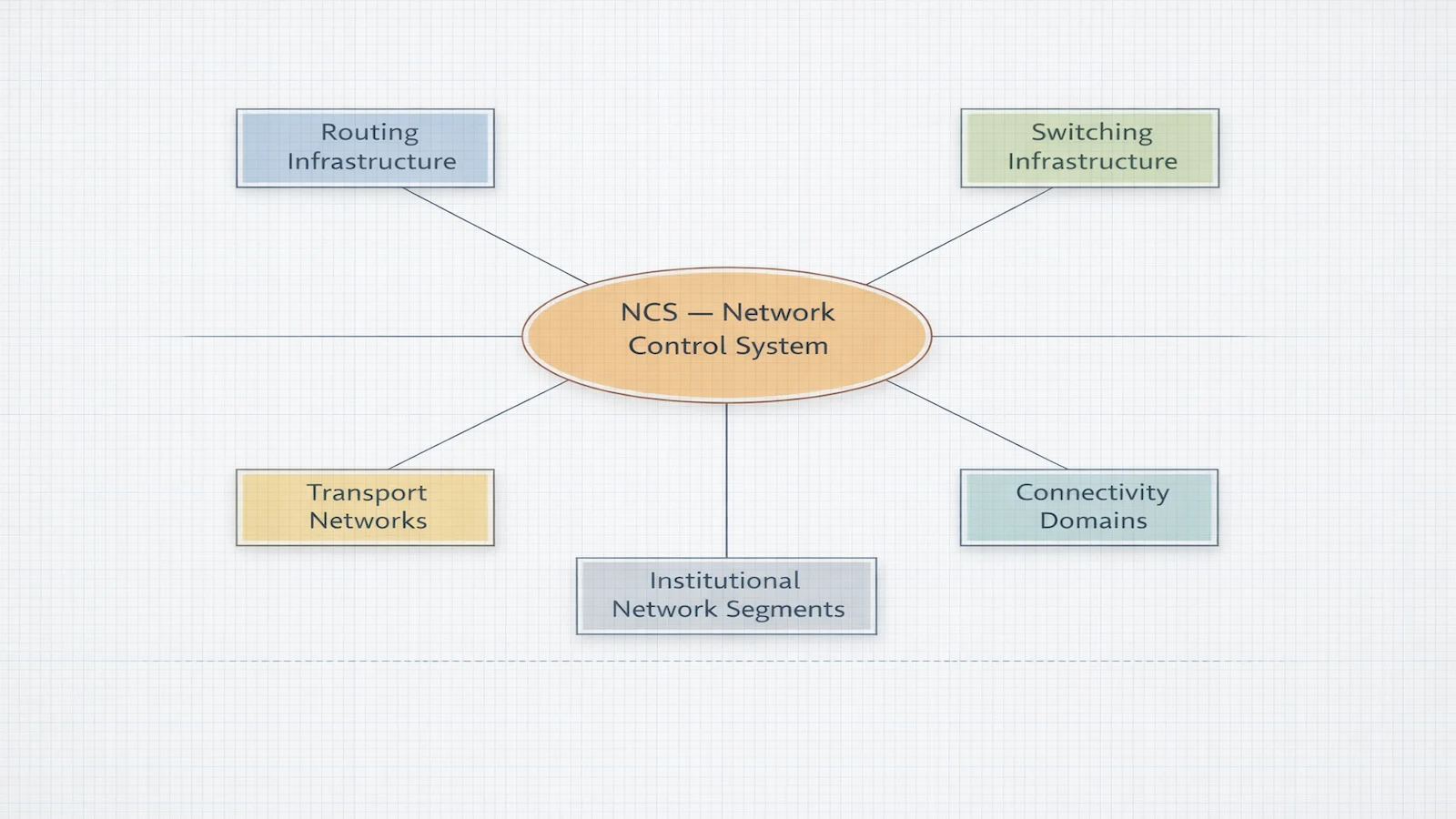
NCS applies deterministic boundaries: identical authorized conditions produce identical permitted behavior, supporting long-horizon auditability and institutional accountability. Where conditions exceed defined limits, where routing becomes ambiguous, or where authority is not explicit, execution is required to yield rather than escalate.
Strategic direction and immunity invariants are defined upstream by institutions, governance frameworks, and layers such as NIIS. NCS applies only what has been formally established — acting as an execution substrate, not a discretionary actor.
In this way, NCS allows network infrastructure to operate at machine timescales without permitting silent drift of authority, unreviewable escalation, or fragile dependence. Network execution remains infrastructure: bounded, legible, and institutionally governed. This structural role also means that execution authority must remain explicitly defined and externally delegated rather than emerging from the behavior of the system itself.
Authority
Execution authority boundaries
Within the DIPA framework, the Network Control System (NCS) operates under a strictly delegated execution authority model. It does not originate authority, define intent, interpret policy, or exercise discretionary judgment.
All execution scope is established upstream through explicit institutional approval. Administrators and governance bodies define routing limits, escalation thresholds, containment conditions, and the circumstances under which execution must constrain, pause, isolate, or yield.
NCS exists solely to apply these boundaries with mechanical consistency. It does not prioritize outcomes, optimize behavior, or expand its mandate through contextual interpretation. Authorized conditions produce uniform, predictable execution across normal operation, stress conditions, partial failure, and contested environments.
Execution capability does not imply decision authority. When authorization becomes unclear, conflicting, or exceeded by prevailing conditions, execution is required to contract rather than escalate. Control is yielded back to institutional governance rather than resolved internally.
This structure preserves institutional sovereignty at network scale, ensuring that execution remains permanently subordinate to explicit authority and never becomes an independent locus of control.
The authority chain can therefore be understood as a structured flow: institutions define execution limits, those limits are translated into explicit operational rules, and NCS applies those rules deterministically across network infrastructure environments.
View Execution Authority Flow
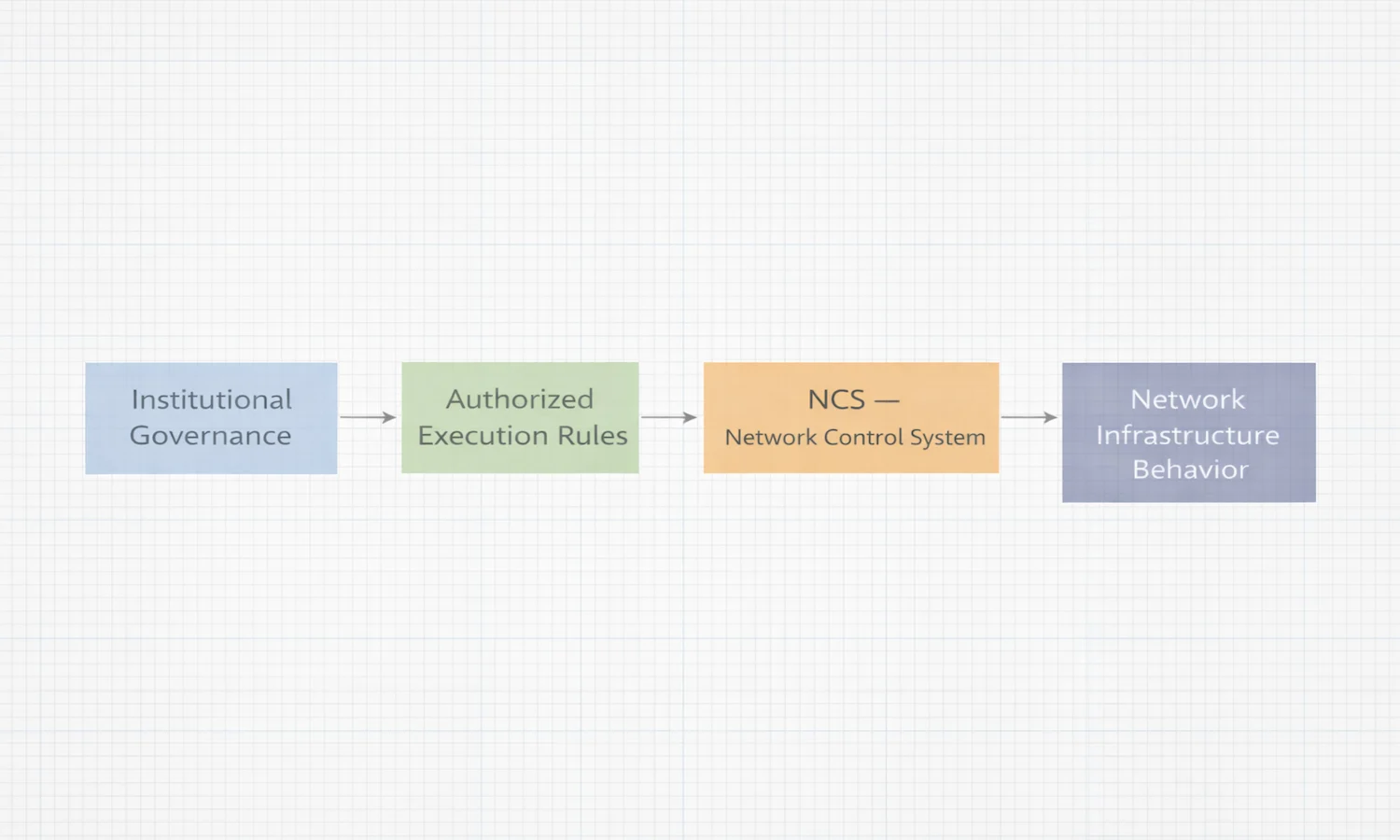
Institutional governance establishes authorized execution rules, which the Network Control System applies deterministically across network infrastructure environments.
By separating authority definition from execution itself, the architecture ensures that networks can operate at machine speed without allowing control to drift away from institutional oversight. Execution remains infrastructure, while authority remains human and institutional.
Purpose
Why NCS exists
Digital networks now operate as foundational public and institutional infrastructure, coordinating machines, services, and organizations at continental and planetary scale. At this level, execution behavior becomes a matter of governance rather than engineering alone.
Within the DIPA framework, the Network Control System exists to establish execution discipline where scale, speed, and complexity exceed the limits of direct human oversight. It ensures that network behavior remains structured, predictable, and institutionally governable by design.
Rather than observing disruption only after the fact, NCS defines how execution is permitted to occur in the first place. It translates institutionally approved authority into enforceable boundaries that hold under normal operation as well as under stress, anomaly, or contested conditions.
This purpose is not optimization or performance. It is continuity. Networks at public scale must remain stable enough to support education, justice, medical infrastructure, and civic operations without allowing localized faults to propagate into systemic disruption or silent escalation of control.
In this way, NCS enables large-scale networks to operate at machine timescales while preserving containment, accountability, and explicit institutional sovereignty over execution.
Because continuity must hold even when networks experience disruption, overload, or abnormal conditions, the execution model must be designed to contain failure rather than react to it after the fact. The architecture therefore establishes containment boundaries in advance, ensuring that execution remains bounded even under stress.
Resilience
Execution containment by design
Within the DIPA framework, the Network Control System is built on the principle that large-scale networks must fail in controlled, legible, and institutionally governable ways. Disruption is treated as an execution condition to be bounded, not as an event that justifies uncontrolled or expansive response.
NCS establishes containment boundaries in advance, defining how far execution may extend under stress and where it must stop. This ensures that localized anomalies remain localized by architectural construction, preventing cascade effects across interconnected domains.
Containment is not a single mechanism. It is a layered operational posture that preserves continuity while keeping authority legible under abnormal conditions.
Execution is constrained within predefined scopes so anomalies cannot propagate beyond explicitly authorized limits.
Containment is applied narrowly where required, while unaffected domains continue operating normally rather than triggering full systemic shutdown.
Under strain, non-essential execution contracts first, preserving core institutional and service continuity as long as possible.
When operating conditions exceed containment boundaries, execution is required to yield back to institutional authority for resolution rather than escalating autonomously.
Rather than maximizing reaction, NCS prioritizes predictable behavior, continuity, and reviewability. Execution remains structured, bounded, and aligned with governance intent at all times.
Operation
Execution model
Within the DIPA framework, the Network Control System operates as a deterministic network execution layer. Its behavior is defined entirely by preapproved execution rules and boundary conditions rather than by runtime interpretation, optimization, or adaptive discretion.
Network behavior is governed through an explicit execution grammar: what actions are permitted, under which conditions, and within what scope. NCS applies this grammar uniformly across environments so that execution remains predictable, repeatable, and institutionally legible.
When operating conditions remain within authorized limits, execution proceeds normally. When conditions approach or exceed those limits, execution is constrained or contracted according to predefined posture, preserving containment and continuity without improvisation.
NCS does not negotiate trade-offs or invent responses. Where governance, immunity enforcement, or higher-layer intervention is required, execution yields rather than escalates. Responsibility remains layered: intelligence, immunity, machine control, and network execution do not collapse into a single locus of authority.
This execution model ensures that network behavior remains auditable, accountable, and governable regardless of scale, load, or operational complexity — infrastructure that institutions can rely on over time.
Oversight
Auditability & traceability
Within the DIPA framework, the Network Control System is designed to operate as auditable public and institutional infrastructure. Every execution outcome is attributable to an explicitly authorized rule, a defined boundary, and a verifiable moment in time.
Auditability is not an afterthought or an external monitoring layer. Execution records are produced as a first-class system output, generated directly from deterministic control paths so that behavior remains legible without reliance on inference, discretion, or retrospective reconstruction.
This traceability enables governance at scale: institutions can review what occurred, regulators can verify adherence to authorized constraints, and responsibility remains visible across the full lifecycle of operation. Outcomes are not opaque effects — they remain linked to the authority that established the governing rules.
Audit data remains under institutional control and is structurally separated from intelligence functions, profiling, surveillance, or behavioral inference. The purpose is accountability, not visibility into people — ensuring that network execution remains reviewable as infrastructure rather than discretionary power.
Applications
Infrastructure domains
The Network Control System (NCS) is designed for environments where network execution carries institutional, civic, or systemic consequence. In these domains, execution is no longer a purely technical concern. It becomes part of continuity, safety, legitimacy, and public trust.
While implementation differs across sectors, the underlying requirement remains constant: network execution must remain bounded, auditable, and explicitly governed, even as scale, automation, and complexity increase.
As digital infrastructure converges across public life, networks increasingly coordinate actions that affect physical systems, essential services, and institutional outcomes. NCS provides a shared execution discipline that allows sectors to evolve independently without allowing authority to drift into opaque or unreviewable behavior.
Medical and clinical networks require continuity, accountability, and governance clarity, where execution failures may translate directly into preventable harm.
Power, water, and essential utilities depend on controlled execution under stress, degradation, and transition, where stability is a public requirement rather than an operational preference.
Public movement systems coordinate safety-critical operations at scale, where execution decisions carry direct societal consequence.
Core network infrastructure operates at regional and national scale, requiring execution behavior that remains institutionally governable even under contested or abnormal conditions.
Where machine execution intersects with network control, parallel governance discipline is required to prevent propagation across interconnected physical systems.
State systems and civic infrastructure depend on legitimacy, auditability, and continuity, where execution must remain subordinate to explicit authority and long-term public accountability.
Boundaries
What NCS is not
The Network Control System (NCS) is deliberately constrained to prevent authority accumulation as network environments expand in scale, complexity, and criticality. Its purpose is execution discipline, not discretionary control.
NCS does not surveil individuals, inspect user content, interpret intent, or construct behavioral narratives. It does not score, predict, learn, or operate as an intelligence layer. Its scope is limited strictly to network execution states and authorized boundary conditions.
The system does not define policy, establish priorities, or exercise governance authority. All rules and intent are defined externally through institutional approval and integrity architecture, and execution is applied without reinterpretation or expansion of scope.
These exclusions are not configuration options or deployment preferences. They are foundational design constraints that ensure NCS remains an execution substrate rather than a decision-maker, and that network control remains permanently subordinate to explicit human and institutional authority.
Scope
Network scope & boundaries
The Network Control System (NCS) interacts exclusively with network infrastructure and execution environments, including routing, switching, transport, connectivity layers, and protocol-level behavior.
Its visibility and control are limited to network state, traffic flow, and execution conditions within declared segments. NCS does not access application logic, user data, content semantics, or any human-facing interface layer.
Scope is not emergent and cannot expand dynamically. Control boundaries are defined explicitly at deployment through administrative configuration and architectural separation, ensuring that execution remains confined to institutionally authorized domains.
Any modification of scope requires explicit administrative authorization and remains subject to institutional review, governance oversight, and audit traceability. Attempts to exceed declared boundaries are rejected by design and recorded as integrity-relevant events.
In this way, NCS remains a network-only execution layer: bounded, reviewable, and structurally prevented from drifting into application, civic, or discretionary authority domains.
Ecosystem
Relationship to NIIS
Within the DIPA framework, the Network Control System (NCS) operates as the network execution governance layer coordinated with the Network Integrity & Immunity System (NIIS). Together these systems ensure that network behavior remains both immediately bounded and structurally survivable at institutional scale.
This relationship preserves a deliberate separation between execution-speed control and system-wide immunity authority. Fast containment occurs locally through deterministic network control, while escalation decisions remain conservative, reviewable, and institutionally governed.
NIIS defines escalation logic, enforces systemic invariants across domains, and coordinates containment when conditions exceed local execution scope. It evaluates cross-network patterns, systemic risk indicators, and multi-layer signals to determine when localized execution controls are no longer sufficient to preserve infrastructure stability.
NIIS does not manage individual routes, packets, or traffic flows. Its authority is architectural and systemic: preserving immunity boundaries across the broader infrastructure environment.
NCS applies institutionally approved execution rules at network speed, enforcing segmentation, regulation, and bounded control within explicitly authorized operational scope.
When execution conditions approach or exceed defined thresholds — such as coordinated attack patterns, systemic instability, or cross-layer risk — NCS signals escalation but does not assume immunity or governance authority. Execution yields upward rather than expanding autonomously.
By isolating fast execution from systemic immunity judgment, DIPA enables immediate local restraint while preserving coordinated oversight over conditions that affect broader infrastructure stability.
The relationship can therefore be understood as a parallel control model in which execution and immunity operate in coordination while remaining structurally separated.
View NIIS–NCS Relationship Diagram
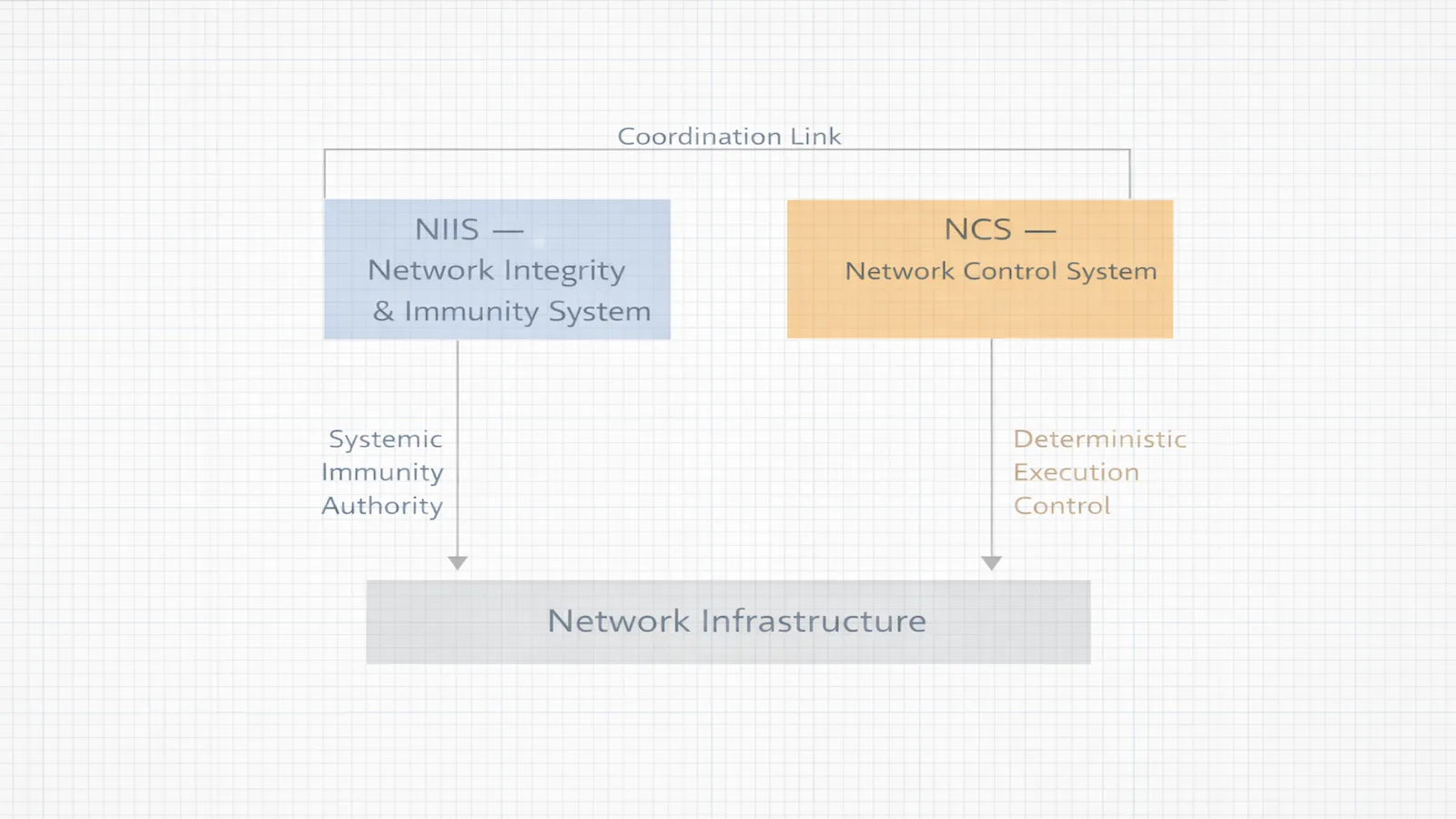
NIIS provides systemic immunity authority across the infrastructure environment, while NCS governs deterministic execution within network boundaries. The separation preserves rapid containment without allowing execution layers to accumulate institutional authority.
This architectural separation ensures that infrastructure can respond rapidly to operational conditions while maintaining long-term institutional oversight. Execution remains bounded within network control layers, while systemic protection remains coordinated through the broader immunity architecture. The principles, execution models, and governance boundaries described here are documented in greater technical depth within the NCS publications and research materials provided below.
Publications
NCS Documents & References

NCS Whitepaper
Governed network execution scope and infrastructure boundaries.
OPEN DOCUMENT →
Research & Analysis
Execution governance, containment models, and stability research.
OPEN DOCUMENT →
Whitepaper Library
Browse all official NCS and ARMI architecture publications.
EXPLORE LIBRARY →
Research & Architecture
Analytical papers and infrastructure research studies.
EXPLORE RESEARCH →System Integrity
Continue through the Integrity Layers
The systems below form the machine and infrastructure integrity layers of the ARMI architecture. They operate beneath civic interfaces to preserve execution boundaries, maintain operational stability, and ensure that technical systems remain constrained by institutional governance.
Each layer performs a distinct role within the integrity stack. Explore adjacent components of the architecture below.

NAVI
Situational synthesis and advisory reasoning.
LEARN MORE →
NIIS
Infrastructure immunity and systemic safety constraints.
LEARN MORE →
MCS
Deterministic machine execution governance.
LEARN MORE →
NCS
Network routing boundaries and isolation control.
LEARN MORE →
Guardian Switch
Sovereign isolation hard-stop for exceptional conditions.
LEARN MORE →
Kernel
Deterministic execution substrate with capability boundaries.
LEARN MORE →Institutional context
A public network governance component
The Network Control System (NCS) is not a product, a platform, or a network optimization engine. It is an architectural component within the DIPA framework, designed to support long-term public and institutional infrastructure.
Its role is structural: maintaining clear execution boundaries so that network behavior remains predictable, reviewable, and stable as infrastructure environments grow in scale and complexity.
By separating execution from decision-making layers, the architecture preserves clarity across the system stack. Networks continue operating at machine timescales while higher-level institutional and civic processes remain responsible for direction and oversight.
In this way, network execution remains part of the infrastructure itself — bounded, legible, and aligned with the long-horizon stewardship required for public systems.
The Network Control System exists to keep execution reliable, constrained, and understandable within the broader public infrastructure architecture.