

Execution Layer
MCS
Machine Control System
Deterministic control across machine environments, keeping execution bounded, stable, and predictable at scale.
Reliable · Scalable · Real-world ready
Overview
Execution control within public infrastructure systems
The Machine Control System (MCS) is the execution-layer control component within DIPA (Digital Infrastructure for Public Access). It governs how machine-scale infrastructure environments carry out authorized operations across public, industrial, and critical systems.
Contemporary infrastructure consists of interconnected fleets of devices, sensors, controllers, and automated machinery operating at machine timescales. In such environments, execution behavior must remain consistent, bounded, and institutionally governed.
MCS enforces deterministic execution boundaries across heterogeneous machine systems. It applies institutionally approved rules with mechanical consistency, precision, and auditability.
In this role, MCS enables infrastructure systems to operate at speed while remaining structurally aligned with human, legal, and institutional authority.
Framework alignment
MCS within the DIPA public infrastructure framework
The Machine Control System (MCS) is an execution-layer infrastructure component within DIPA (Digital Infrastructure for Public Access). DIPA defines the institutional and governance framework within which systems such as MCS are deployed, operated, and overseen across long public lifecycles.
MCS originated within the ARMI research environment as part of a broader architectural effort to separate intelligence, execution, and authority in machine-scale infrastructure. Within DIPA, this work is expressed as public infrastructure capability under institutional governance.
MCS operates only within institutionally governed deployments, where execution scope, boundaries, and escalation posture are defined through authorized policy and oversight.
The system applies these constraints deterministically, ensuring that machine execution remains reviewable, auditable, and structurally aligned with institutional authority.
This alignment ensures that execution control remains stable, accountable, and sustainable across decades of infrastructure evolution.
View NIIS execution architecture
IoT & AI devices
Governing execution in AI-augmented machine environments
Public and industrial infrastructure is entering a phase in which essential services depend on vast, continuously operating machine environments. Cities, utilities, transport systems, and industrial facilities now rely on millions of interconnected sensors, controllers, actuators, robotics platforms, and AI-assisted devices.
Many of these environments increasingly incorporate local intelligence: systems can perceive conditions, forecast outcomes, and propose optimized behavior. Intelligence alone, however, does not produce governable infrastructure. At scale, opaque or unbounded execution becomes a systemic institutional risk.
Two pressures now exist simultaneously. Human supervision does not scale to IoT-dense environments, yet delegating execution authority directly to devices or proprietary platforms undermines accountability, legal responsibility, and public trust.
MCS addresses this tension by governing execution rather than expanding autonomy. It does not seek to make machines more capable. It ensures that execution outcomes — regardless of how they are proposed or computed — remain bounded by institutionally defined authority and explicit rules.
MCS is not an intelligence system and does not compete with edge or platform reasoning. Intelligence may analyze, predict, or recommend; systems may request actions; but execution itself remains deterministic, auditable, and subject to human and institutional control.
This separation enables large-scale machine deployments without loss of institutional sovereignty. Responsibility remains clear during faults or incidents, governance remains vendor-neutral and reviewable, and execution authority cannot silently migrate into firmware, opaque orchestration layers, or automated decision loops.
As AI-enabled infrastructure proliferates, the central requirement is not more intelligence, but more legibility: execution that remains visible, accountable, and structurally restrained as complexity grows.
The relationship between machine intelligence and execution control can be visualized as a layered interaction. Analytical systems may generate recommendations or operational proposals, but execution authority remains structurally separated and enforced through the Machine Control System. The diagram below illustrates this separation.
View execution governance structure
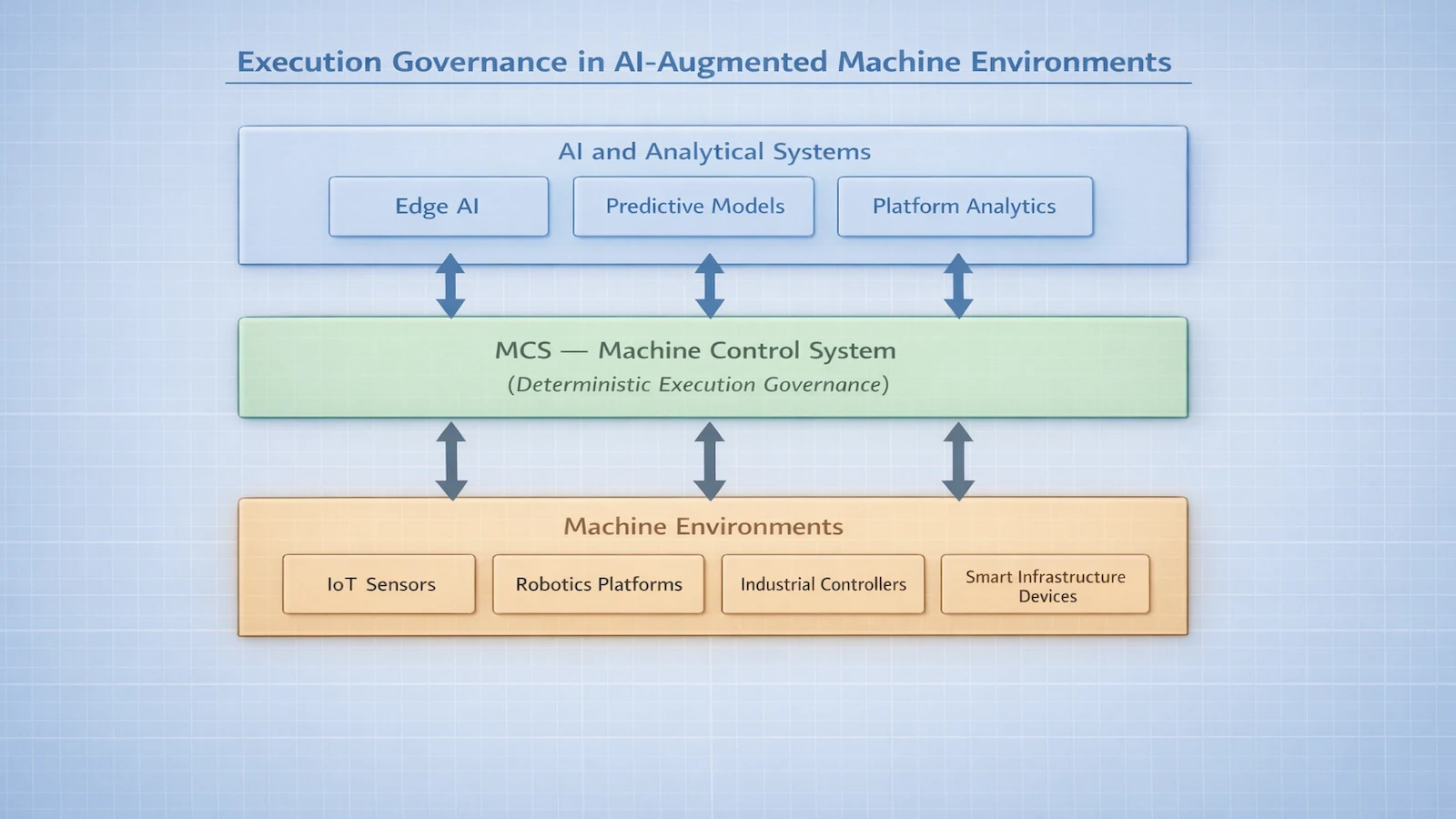
Maintaining this structural separation ensures that execution authority does not migrate into analytical platforms, proprietary device firmware, or automated optimization loops. Instead, all machine actions remain bounded by formally authorized operational limits.
This architectural principle leads directly to the execution authority model that governs how MCS applies institutionally approved rules across machine environments.
Authority
Execution authority model
Within the DIPA framework, the Machine Control System (MCS) operates under a strictly delegated execution authority model. All execution authority applied by MCS is defined upstream through formally approved institutional rules, procedures, and governance.
Execution speed does not imply decision-making authority. MCS applies granted boundaries exactly as specified, without optimization or reinterpretation. Its function is mechanical, deterministic, and structurally bounded.
Institutions and administrators define scope limits, escalation thresholds, and the legal basis for execution. MCS enforces only what has been explicitly authorized.
This separation enables infrastructure to operate at machine timescales while keeping responsibility and authority within human and institutional governance.
MCS executes. Institutions govern.
Purpose
Why MCS exists
Contemporary public and industrial infrastructure increasingly depends on vast machine environments spanning physical assets, automated platforms, and hybrid execution layers. At this scale, execution behavior itself becomes a matter of institutional governance rather than engineering convenience.
Fragmented control, delayed human intervention, or opaque automation can allow localized faults to propagate across interdependent services, disrupting essential operations and weakening clear responsibility.
The Machine Control System exists to prevent this class of failure. Its purpose is to impose execution discipline, deterministic behavior, and structural coherence across machine environments, continuously and at infrastructure scale.
MCS ensures that machine systems can grow in complexity and capability without becoming unstable, unaccountable, or ungovernable over time.
Execution remains scalable only when authority remains explicit.
Resilience
Failure containment strategy
In large-scale infrastructure environments, failures are not exceptional events. They are an expected condition of operation. The central risk is not that faults occur, but that execution failures propagate beyond their point of origin and disrupt dependent systems.
The Machine Control System (MCS) is designed to ensure that localized machine instability does not become systemic disruption. Faults are treated as bounded execution events — not as triggers for uncontrolled, infrastructure-wide escalation.
Containment responses are predefined, proportional, and aligned with institutionally approved priorities. The system favors continuity, orderly degradation, and recoverable stability over abrupt shutdown or discretionary expansion of control.
When execution anomalies emerge, MCS constrains impact to the smallest possible radius. Local faults are structurally prevented from cascading across machine fleets, interconnected services, or shared execution environments.
Where full operation cannot be safely sustained, MCS preserves essential services while suspending or contracting non-critical activity. This enables infrastructure continuity under stress without triggering abrupt, system-wide interruption.
In all cases, containment remains legible, auditable, and subordinate to institutional authority. Failure is survivable because execution is bounded by design.
In practice, this containment model follows a structured response path. Detection, isolation, and controlled degradation occur within defined execution boundaries so that instability remains localized and the wider infrastructure continues operating safely.
View failure containment flow
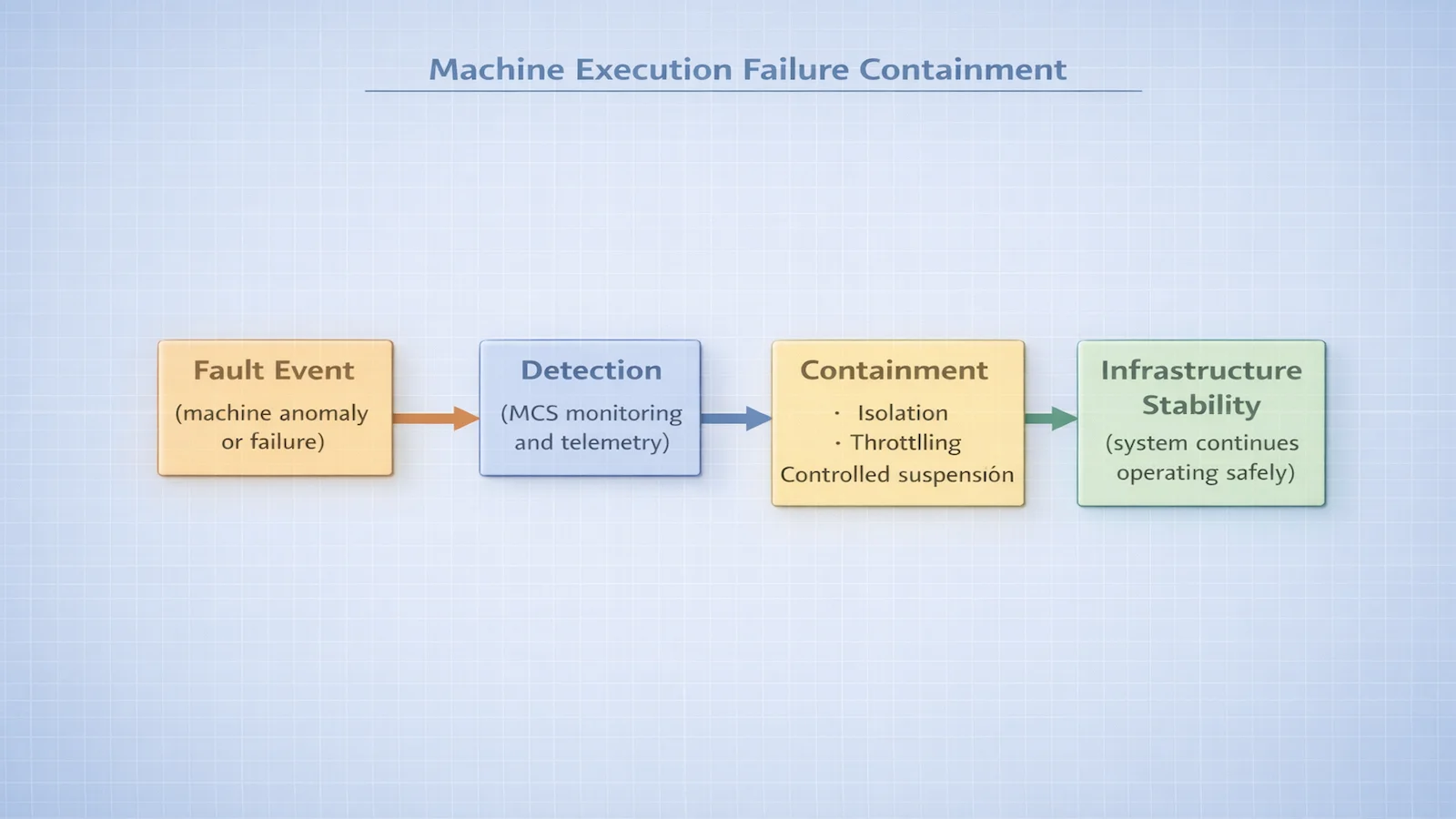
Because containment behavior is predefined rather than improvised, infrastructure stability does not depend on real-time interpretation or discretionary reaction. Instead, execution control follows a deterministic operational model.
Understanding this deterministic control process requires examining how the Machine Control System evaluates machine states and applies execution boundaries during normal operation.
Operation
How MCS operates
The Machine Control System operates as a deterministic execution governance layer. It continuously evaluates machine execution states against institutionally approved limits using predefined control logic and real-time infrastructure telemetry.
Its role is not interpretive. MCS does not infer intent, negotiate context, or exercise judgment. Execution authority is granted upstream, and the system applies that authority mechanically — with consistency, speed, and auditable restraint.
When operating conditions remain within authorized boundaries, execution proceeds normally. When conditions deviate beyond defined thresholds, MCS applies only predefined containment responses such as isolation, throttling, suspension, or controlled shutdown.
All execution behavior remains uniform across load, stress, partial failure, or rapidly changing environments. MCS does not adapt through autonomous improvisation. It enforces what has been formally approved, and yields beyond execution whenever governance escalation is required.
This operating model ensures that large-scale machine environments remain predictable, reviewable, and institutionally governable even at machine timescales.
In practice, this governance model operates as a continuous control cycle. Machine states are observed through infrastructure telemetry, evaluated against authorized execution rules, and allowed to proceed only when conditions remain within approved boundaries.
View execution control cycle
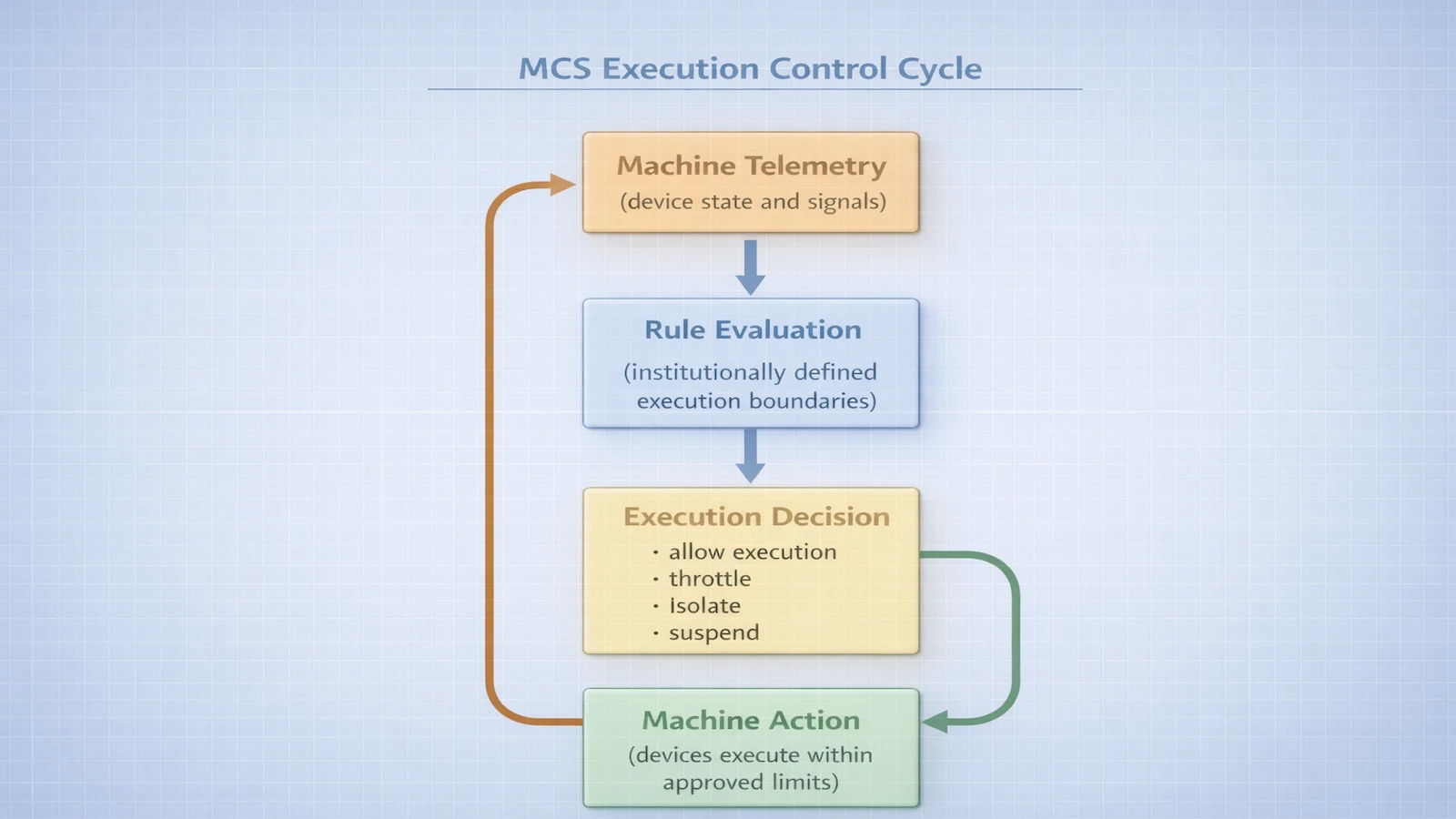
Because execution authority remains bounded within this deterministic control cycle, machine environments can operate at infrastructure scale without allowing execution behavior to drift into opaque automation or uncontrolled autonomy.
For the canonical execution boundary structure in which MCS operates, see the full → View System Architecture →
Oversight
Auditability & traceability
Because execution within the Machine Control System (MCS) follows a deterministic control cycle, every action applied to machine environments remains structurally attributable to authorized rules and execution conditions. In public and institutional infrastructure, this property is essential: execution authority must remain visible, reviewable, and accountable across long operational lifecycles.
This traceability is not an external compliance layer or a retrospective monitoring feature. It is a structural property of the execution model itself: machine behavior must always remain reconstructible, legible, and institutionally accountable after the fact.
Execution outcomes are recorded as deterministic, time-ordered system outputs generated directly from authorized control paths. This ensures that institutional review does not rely on inference, vendor opacity, or discretionary interpretation of machine behavior.
These records support post-incident reconstruction, compliance verification, and long-horizon governance review without interfering with real-time operation or execution performance.
All audit data remains under the custody of the operating institution and is accessed only through established legal, regulatory, and oversight procedures. MCS does not create independent inspection authority — it preserves execution accountability within governance.
In this way, machine execution remains permanently attributable to human-approved rules rather than drifting into opaque automation or unreviewable control.
Oversight
Human oversight & intervention
Within the DIPA framework, machine execution never replaces institutional authority. The Machine Control System (MCS) operates only under continuous human and organizational oversight, through administrative control structures designed for review, configuration, and authority management.
Authorized officials and operators retain unconditional capacity to intervene at any time: modifying execution parameters, suspending specific control pathways, or halting machine behavior in accordance with established legal and procedural requirements.
This ensures that infrastructure systems may operate at machine timescales without allowing execution authority to drift away from accountable human control over scope, limits, and operational continuity.
Intervention authority is not an exceptional emergency feature. It is a permanent structural condition of the execution model itself.
Execution rules and thresholds are not modified through informal tuning or discretionary system evolution. Updates occur only through documented, policy-controlled processes: formal review, explicit authorization, and controlled institutional deployment.
This preserves stability, predictability, and accountability across long infrastructure lifecycles, ensuring that execution governance remains institutionally legible even as machine environments evolve.
Boundaries
What MCS is not
The Machine Control System (MCS) is deliberately and permanently constrained by design. Its responsibility is limited to execution control within explicitly authorized operational boundaries defined by institutions.
Execution discipline at infrastructure scale requires restraint. MCS does not interpret intent, originate policy, redefine authority, or expand its scope through learning, adaptation, or autonomous judgment.
These limits are not procedural safeguards or deployment preferences. They are structural properties of the execution layer itself — ensuring that capability never becomes discretionary power.
MCS does not determine priorities, resolve trade-offs, or produce institutional outcomes. Governance, law, and policy remain external, human-led, and formally accountable. The execution layer applies only what has already been approved — and nothing beyond it.
MCS does not evaluate people, interpret social behavior, profile users, or operate as an intelligence or surveillance function. Its scope is strictly technical: machine execution states, boundary conditions, and authorized control pathways.
MCS does not initiate authority, evolve into a governing system, or bypass institutional operators. Execution behavior remains fully derived from explicit rules, documented procedures, and continuous oversight — preserving long-term clarity of responsibility, legitimacy of governance, and accountability of machine action.
By defining what MCS is not, the architecture ensures that machine environments can scale in complexity without accumulating hidden authority, institutional ambiguity, or irreversible autonomy.
System integration
MCS within the DIPA architecture
Within DIPA (Digital Infrastructure for Public Access), the Machine Control System (MCS) functions as the execution-layer control component responsible for governing how machines and devices are permitted to act at runtime across infrastructure environments.
MCS originated within the ARMI research framework as part of a layered architecture designed to preserve separation between execution, network coordination, and system-wide safety enforcement. These responsibilities do not overlap, and no single layer is permitted to accumulate full-stack authority.
Execution speed, coordination scope, and immunity governance are therefore distributed intentionally across independent systems. This prevents authority conflict, functional drift, or ambiguous responsibility under stress, scale, or exceptional operating conditions.
Each layer operates at full technical capability within its defined role, while remaining structurally subordinate to institutional governance and explicit escalation pathways.
Governs machine and device execution at runtime, enforcing institutionally approved rules and operational boundaries with deterministic control across heterogeneous environments.
Governs network coordination, traffic behavior, segmentation, and containment across distributed infrastructure systems, ensuring that execution remains bounded at the network layer.
Governs system-wide immunity, escalation logic, and cross-domain containment posture, preserving infrastructure integrity when abnormal or adversarial conditions exceed local execution scope.
View execution domain structure
Ecosystem
Relationship to NIIS
Within the DIPA architecture, the Machine Control System (MCS) operates strictly at the machine execution layer. Its authority is limited to enforcing institutionally approved rules on devices, controllers, and runtime environments — nothing more.
System-wide safety, immunity logic, escalation thresholds, and cross-domain containment are governed exclusively by the Network Integrity & Immunity System (NIIS). MCS does not evaluate systemic risk, correlate patterns across domains, or make determinations about broader infrastructure danger.
As long as execution conditions remain local, bounded, and within declared operating parameters, MCS applies control deterministically and mechanically. It does not interpret whether a condition is exceptional, adversarial, or institutionally consequential. Its role is execution discipline, not judgment.
When machine-layer conditions exceed predefined limits or intersect with infrastructure-wide safety concerns, MCS yields upward. It signals escalation, contracts execution, and defers. NIIS alone governs the coordinated immunity posture and containment decisions that affect the wider system.
This separation preserves the core integrity principle of DIPA: execution may operate at machine speed, but immunity authority remains conservative, institutionally governed, and structurally unreachable by execution layers.
MCS executes. NIIS safeguards. Authority does not collapse.
View authority and execution structure
Scope
Machine scope & boundaries
The Machine Control System (MCS) operates exclusively within machine execution environments. Its authority is confined to devices, controllers, runtimes, and coordination layers that carry out institutionally approved actions inside infrastructure systems.
This scope is deliberately narrow. MCS does not interface with people, communications, content, intent, or civic decision processes. It does not observe social behavior, interpret context, or participate in governance. Its role begins and ends at execution control.
Execution boundaries are not procedural guidelines. They are structural constraints embedded into deployment architecture. Control surfaces are explicitly declared, documented, and enforced at integration time, and cannot expand dynamically through learning, inference, configuration drift, or operational convenience.
Any modification of scope requires formal institutional authorization and architectural revision. This ensures that execution capability cannot silently accumulate into discretionary authority as machine environments grow in scale, complexity, or autonomy pressure.
In this way, MCS preserves a permanent boundary: machine execution remains governable infrastructure, never a pathway to mission creep, hidden control, or unreviewable extension of power.
Deployment
Where MCS operates
The Machine Control System (MCS) is designed for environments in which machine execution must remain stable, predictable, and continuously governable under real-world operating conditions and institutional oversight.
It supports both centralized and distributed deployments and operates across heterogeneous hardware platforms, operating systems, and execution environments without assuming uniformity of vendors, stacks, or control architectures.
MCS is applicable wherever execution reliability is mission-critical, failure propagation is unacceptable, and responsibility must remain clearly attributable to human and institutional authorities.
In these contexts, MCS functions as a foundational execution discipline layer rather than as a sector-specific solution.
Long-lived civic and institutional assets — including buildings, transportation networks, utilities, and critical service environments — where execution stability and accountability are essential over decades of operation.
Manufacturing systems, robotics platforms, and large-scale automated facilities operating under strict safety, continuity, and containment requirements where execution faults cannot be allowed to propagate.
Data centers, clusters, edge environments, and distributed control planes coordinating machine execution at scale — where deterministic boundaries are required to preserve institutional oversight.
City-scale and institutional digital systems supporting essential public functions, where execution behavior must remain auditable, bounded, and governable across evolving technical and administrative contexts.
Evolution
Evolution & extensibility
The Machine Control System is designed to evolve only through deliberate, institutionally governed extension — not through open-ended feature accumulation, platform drift, or discretionary expansion over time.
Evolution within MCS is permanently constrained by its core execution role: enforcing deterministic machine behavior without absorbing intelligence, policy, interpretation, or governance responsibility. Its function remains structural, not adaptive in authority.
New execution capabilities may be introduced only when they preserve architectural boundaries, execution predictability, and full auditability. Changes are not treated as technical upgrades alone, but as governance events requiring formal institutional review, documented authorization, and accountable approval.
This discipline prevents hidden behavior, implicit scope drift, or the gradual migration of authority into execution infrastructure. Extension is permitted only when it strengthens clarity rather than complexity.
By preserving traceability across versions and continuity across decades, MCS remains stable, intelligible, and governable even as machine environments expand in scale, diversity, and technical sophistication.
Execution may evolve — but authority does not.
Publications
Machine Control System Documents & References
MCS Whitepaper
Execution governance defining MCS scope within critical infrastructure.
Concept Paper
Execution without authority and human-governed machine behavior.
Full Document Library
Browse all official MCS and ARMI publications.
EXPLORE →Research & Architecture
Access research papers and analytical infrastructure studies.
EXPLORE →System Integrity
Continue through the Integrity Layers
The systems below form the machine and infrastructure integrity layers of the ARMI architecture. They operate beneath civic interfaces to preserve execution boundaries, maintain operational stability, and ensure that technical systems remain constrained by institutional governance.
Each layer performs a distinct role within the integrity stack. Explore adjacent components of the architecture below.

NAVI
Situational synthesis and advisory reasoning.
LEARN MORE →
NIIS
Infrastructure immunity and systemic safety constraints.
LEARN MORE →
MCS
Deterministic machine execution governance.
LEARN MORE →
NCS
Network routing boundaries and isolation control.
LEARN MORE →
Guardian Switch
Sovereign isolation hard-stop for exceptional conditions.
LEARN MORE →
Kernel
Deterministic execution substrate with capability boundaries.
LEARN MORE →Operational context
Execution across machine environments
The Machine Control System operates within machine environments where execution must remain predictable, bounded, and continuously reviewable. Its responsibility is limited and precise: enforcing institutionally authorized execution conditions across devices, controllers, and automated systems.
Deployment context may vary, from industrial automation to public infrastructure and distributed machine systems, but the role of MCS does not change. It remains an execution discipline layer, ensuring that machine activity proceeds only within explicitly defined operational boundaries.
In this way, machine environments can grow in scale and complexity without allowing execution authority to drift into opaque automation or unreviewable control.
Execution may scale with machines. Authority remains external.