

Architecture
Separation-first,
layered system design
The structural blueprint of Digital Infrastructure for Public Access — defining how civic intelligence, mediation layers, and integrity systems operate within enforced architectural boundaries.
PUBLIC SYSTEMS · ICI · CII · NAVI · SYSTEM INTEGRITY
Structural Design
Architecture as Separation
The ARMI architecture is designed as a separation-first system.
Its purpose is not to maximize capability, but to define structural limits within which capability may operate.
Architecture precedes deployment.
Before systems assist education, justice, medical coordination, or infrastructure continuity, their structural boundaries are defined at the architectural level.
Permanent Constraints
Intelligence does not originate authority.
Execution does not interpret civic meaning.
Governance remains external to computation.
These constraints are not policy preferences. They are architectural conditions enforced through layered design, interface mediation, and domain separation.
Within this model
Civic-facing systems operate through governed interfaces.
Intelligence remains advisory and bounded.
Deterministic execution remains contained.
No layer may bypass structural mediation.
Architecture is therefore not an implementation detail.
It is the mechanism through which institutional authority is preserved while digital capability is introduced.
This page describes the structural design that makes that preservation possible.
System Blueprint
The Unified Structural Model
The ARMI framework operates as a unified but structurally segmented architecture.
It is not a collection of independent systems. It is a layered structure designed to enforce separation, mediation, and bounded coordination.
At the highest level, the architecture consists of two primary domains:
Civic Intelligence Domain
Human-facing systems supporting institutional access.
System Integrity Domain
Infrastructure-level systems preserving containment, stability, and digital immunity.
These domains coordinate through defined interfaces but remain structurally separated.
View macro architecture diagram
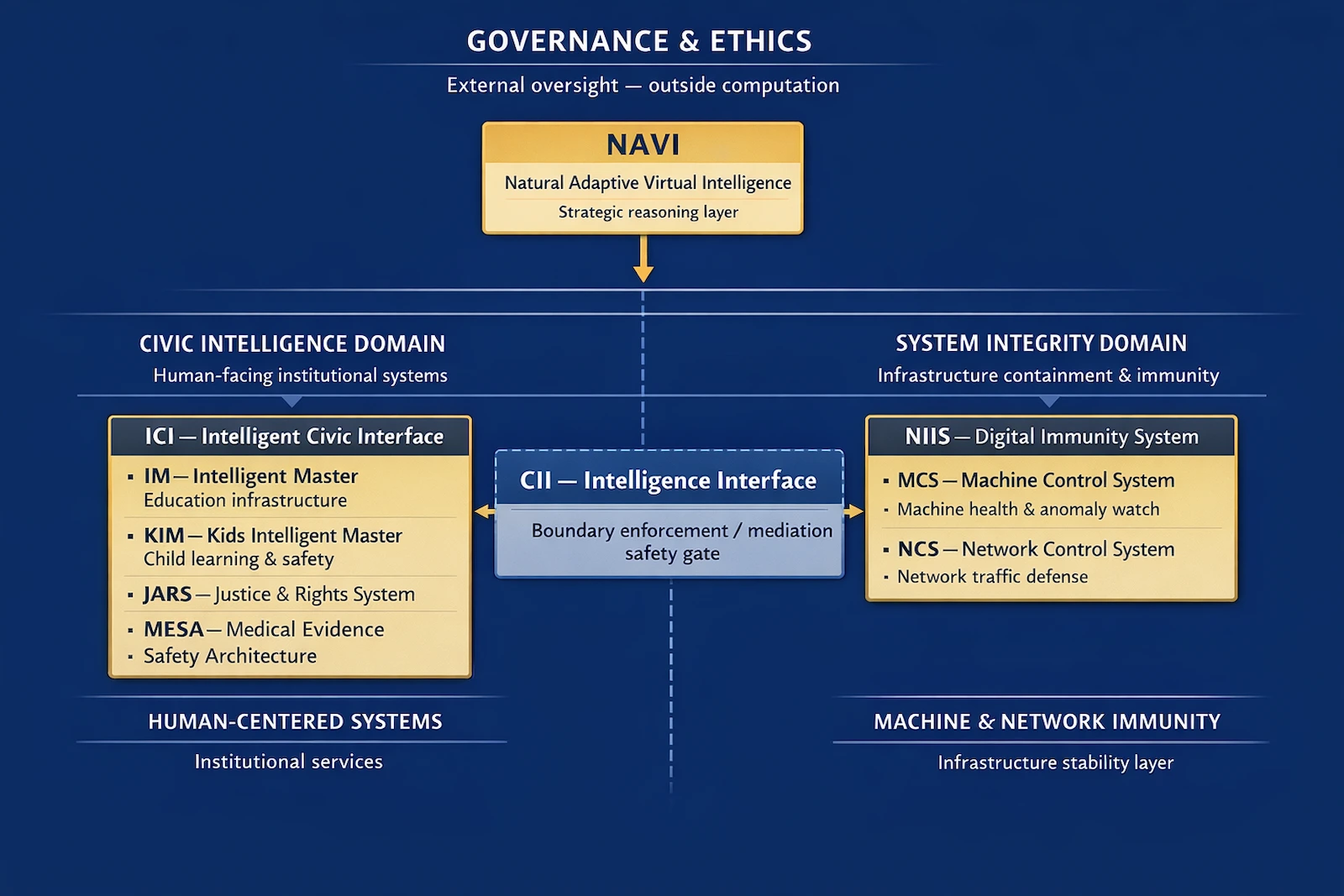
Unified structural model showing domain separation, layered mediation, and governance positioned external to computation.
View full architectural stack
Master structural stack of the ARMI architecture. Civic systems interact through governed interfaces and advisory intelligence layers while system integrity infrastructure preserves deterministic execution and containment beneath the mediation boundary.
Domain Overview
The Civic Intelligence Domain includes:
IM - Institutional learning infrastructure
KIM - Child learning and safety system
JARS - Justice and rights access system
MESA - Medical evidence coordination
These systems operate through governed civic interfaces and remain advisory in function.
The System Integrity Domain includes:
NIIS - Network integrity and immunity
MCS - Machine control system
NCS - Network control system
These systems operate within technical containment layers and do not engage with civic interpretation.
Architectural Mediation
View layered mediation structure
Between these domains exists a layered mediation structure:
Each layer performs a distinct role.
No layer may bypass another. No component may collapse separation between interpretation and execution.
Coordination is permitted. Consolidation is not.
Structural Intent
Intelligence cannot directly control machine execution.
Integrity systems cannot interpret civic context.
Governance remains outside the computational core.
Authority flows downward from institutions, not upward from systems.
Architecture therefore functions as containment logic, not expansion logic.
The remainder of this page details how this separation is enforced at the layer, interface, and control levels.
Boundary Discipline
Layered Separation and Domain Enforcement
Structural Separation as Design Principle
The ARMI architecture enforces separation through layered containment.
Separation is not achieved through policy statements. It is achieved through structural design that restricts how systems interact.
The architecture prevents three forms of collapse:
Civic interpretation merging with execution control
Intelligence bypassing mediation layers
Infrastructure containment becoming civic authority
These are prevented at the architectural level — not through post-hoc governance correction.
Domain Enforcement Model
The framework operates across two structurally distinct domains:
Civic Intelligence Domain
Human-facing, advisory, interpretive.
System Integrity Domain
Deterministic, containment-based, execution-focused.
Between these domains exists a mediation boundary.
No component within the Civic Intelligence Domain may directly invoke machine execution. No component within the System Integrity Domain may directly interpret civic context.
All cross-domain coordination passes through constrained interfaces.
View domain separation diagram
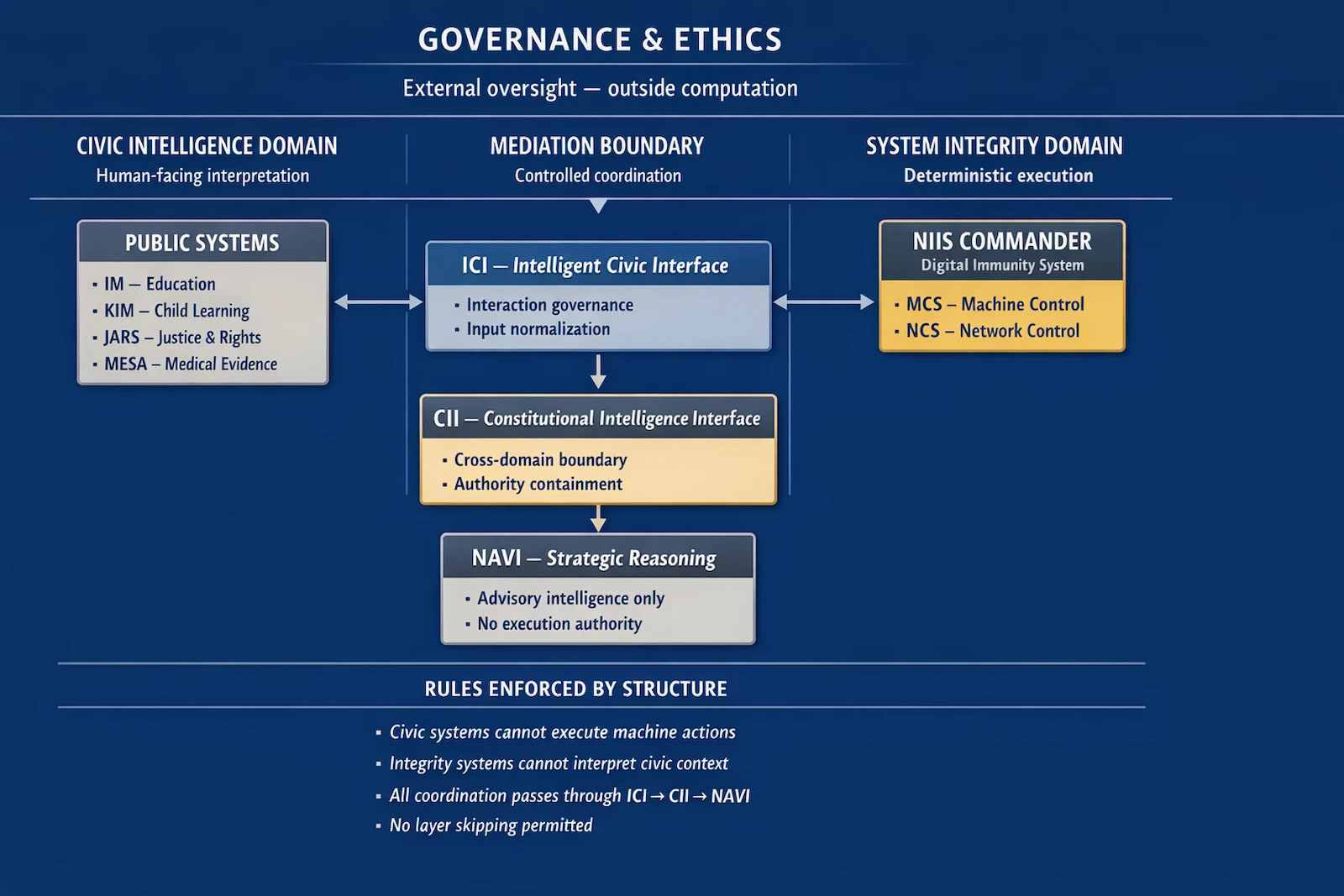
Domain separation model showing civic intelligence systems, mediated interfaces (ICI, CII, NAVI), and system integrity components. All coordination passes through structured mediation layers.
Layered Containment
Each architectural layer performs a limited and isolated role:
Public Systems
Operate within institutional contexts.
Provide structured explanation and contextual synthesis.
ICI (Intelligent Civic Interface)
Acts as the governed interaction surface.
Normalizes input and enforces role constraints.
CII (Central Intelligence Interface)
Implements cross-domain boundary logic.
Prevents authority drift between interpretation and execution layers.
NAVI (Advisory Reasoning Layer)
Produces advisory reasoning only.
Holds no execution privileges.
System Integrity Components (NIIS, MCS, NCS)
Operate in deterministic containment roles.
Execute only within predefined operational parameters.
No layer holds both interpretive and execution authority.
This structural isolation prevents functional accumulation of power.
No Layer Skipping Rule
A core enforcement mechanism is the prohibition of layer skipping.
Requests, reasoning outputs, and execution signals must traverse each intermediate boundary.
Traceability
Auditability
Escalation checkpoints
Role preservation
Even under optimization or scaling conditions, direct cross-layer invocation is structurally restricted.
Architecture therefore constrains speed where necessary to preserve accountability.
Separation as Permanent Condition
Separation is not dependent on operator discretion.
It is encoded into:
Interface permissions
Role-based access controls
Mediation layers
Escalation triggers
Override enforcement
Advisory systems cannot self-promote into enforcement
Execution systems cannot accumulate interpretive authority
Governance remains external and final
Architecture enforces restraint.
Mediation Layer
Interface Architecture and Constitutional Mediation
The Role of Interfaces
Within the ARMI architecture, interfaces are not presentation layers.
They are constitutional enforcement points.
All interaction between civic systems, intelligence reasoning, and infrastructure execution passes through defined interface boundaries. These boundaries regulate role scope, authority origin, and cross-domain communication.
Architecture therefore depends on interface discipline.
ICI — Intelligent Civic Interface
The Intelligent Civic Interface (ICI) is the sole civic-facing interaction surface.
It performs three structural functions:
Role Constraining
It ensures that system responses remain advisory and contextually bounded.
Input Normalization
It structures civic input into defined categories appropriate for advisory reasoning.
Escalation Signaling
It detects conditions requiring institutional review and routes them accordingly.
ICI does not generate authority. It does not execute decisions. It does not interpret beyond defined civic roles.
It is a governed surface — not an autonomous layer.
CII — Central Intelligence Interface
The Central Intelligence Interface (CII) is the internal mediation boundary between civic intelligence and machine-scale infrastructure.
Its purpose is separation enforcement.
CII performs:
Cross-domain validation
Permission enforcement
Boundary verification
Invocation filtering
No reasoning output may directly reach infrastructure layers without passing through CII constraint logic.
CII prevents:
Advisory reasoning from becoming executable command
Execution systems from querying civic interpretation directly
Dual-role accumulation across layers
It is the architectural firewall between interpretation and execution.
NAVI — Advisory Reasoning Layer
NAVI operates beneath the mediation boundary as a reasoning and explanation layer.
Synthesizes contextual inputs
Produces structured advisory outputs
Provides explanation and evidence coordination
It does not:
Execute operational changes
Modify infrastructure state
Originate civic authority
NAVI’s outputs remain proposals until validated and governed externally.
Cross-Domain Flow Logic
When a civic interaction occurs:
Input enters through ICI
ICI enforces role and context constraints
Advisory reasoning is generated through NAVI
Outputs pass through CII validation
If execution is required, institutional authorization is confirmed
Only then may Integrity systems perform deterministic action
No step may be bypassed.
Authority confirmation occurs outside the computational layer.
View interface mediation diagram
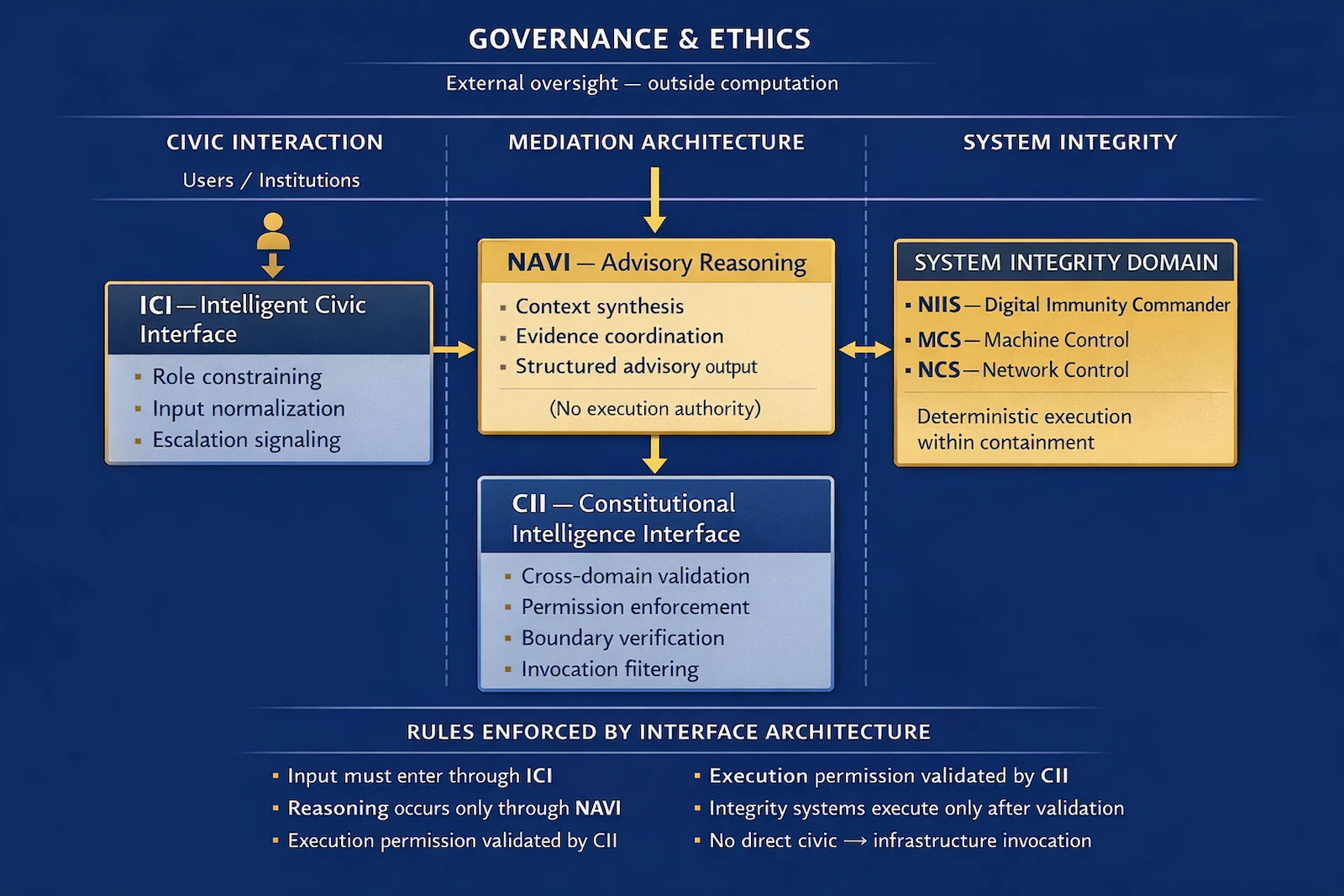
Interface mediation flow showing ICI, NAVI, and CII enforcing separation between civic interaction and system integrity execution, with governance positioned externally above the stack.
Escalation & Override Path
Interface architecture includes structural escalation routes.
If:
Ambiguity exceeds defined limits
Boundary conditions are triggered
Risk thresholds are crossed
The interface terminates advisory flow and routes to institutional review.
Override authority remains external and permanent.
Interfaces enforce escalation rather than absorb it.
Structural Effect
Civic interpretation remains separate from execution control
Advisory intelligence cannot accumulate enforcement capacity
Infrastructure systems remain operationally bounded
Governance remains final and external
Interface architecture is therefore the core safeguard of the system.
It is not a usability layer. It is a constitutional boundary.
Structural Constraints
Control Logic and Architectural Invariants
Architectural Control Logic
The ARMI architecture is governed by enforced flow constraints.
These constraints regulate how information, reasoning, authorization, and execution move across layers.
Control logic exists to prevent functional accumulation of power within any computational component.
Architecture therefore defines not only structure — but directionality.
One-Way Intelligence Flow
Advisory intelligence flows upward through mediation layers.
Inputs are interpreted
Context is synthesized
Reasoning is generated
However:
Intelligence does not flow downward as command authority
Advisory output does not automatically become executable instruction
All downward action requires institutional validation external to the computational stack.
One-Way Authority Flow
Authority flows downward from human institutions.
Institutions define:
Scope of operation
Permissible execution boundaries
Escalation thresholds
Override rights
Authority does not originate within intelligence systems.
No reasoning layer may self-authorize action.
Authority confirmation occurs outside the architecture, then re-enters through governed channels.
No Dual-Role Accumulation
No architectural component may simultaneously:
Interpret civic context
And execute deterministic control
This prohibition prevents:
Civic interpretation merging with infrastructure command
Advisory reasoning becoming implicit enforcement
Optimization becoming authority
Functional separation is permanent.
No Layer Skipping
All operations must traverse adjacent architectural layers.
Direct invocation across non-adjacent layers is structurally restricted.
Traceability
Audit checkpoints
Escalation opportunities
Governance visibility
Performance optimization may not remove mediation layers.
Efficiency does not override boundary enforcement.
Escalation Termination Rule
When defined uncertainty, risk, or boundary thresholds are exceeded:
Computational flow halts
Escalation transfers control to institutional review
The system does not attempt autonomous resolution of boundary conditions.
Override Permanence
Institutional override is not an exception case.
It is a permanent structural condition.
Institutions retain the ability to:
Suspend execution
Restrict operational modes
Terminate deployment
Modify scope
Architecture must remain subordinate to governance at all times.
Structural Summary
Intelligence assists without commanding
Execution performs without interpreting
Interfaces mediate without accumulating authority
Governance remains external and final
Architecture is defined by constraint.
It operates through limits, not expansion.
Constitutional Integrity of Design
The ARMI architecture is defined by structural restraint.
It does not centralize authority.
It does not collapse domains.
It does not merge interpretation with execution.
Each layer exists within defined limits.
Each interface enforces separation.
Each control rule preserves institutional supremacy.
Architecture therefore operates as containment before capability.
Digital systems may scale.
Structural boundaries do not.