

Ecosystem
A federated network of
sovereign public systems
Structurally aligned across jurisdictions, institutionally governed within each region, expanding through replication, not centralization.
FEDERATED · SOVEREIGN · NON-CENTRALIZED · GOVERNANCE-BOUND
Ecosystem Model
A Federated Public Infrastructure Network
The ARMI ecosystem is not a single centralized system.
It is a federated network of institution-anchored systems operating within shared architectural principles while remaining governed by local authority.
Each participating jurisdiction implements the framework through its own educational institutions, courts, clinical governance bodies, and infrastructure administrators.
Architectural alignment ensures structural consistency. Governance remains sovereign.
To understand how participating systems relate structurally, the ecosystem can be viewed as a coordinated architecture composed of civic systems, mediation layers, and integrity infrastructure operating within institutional governance.
View ecosystem structural composition
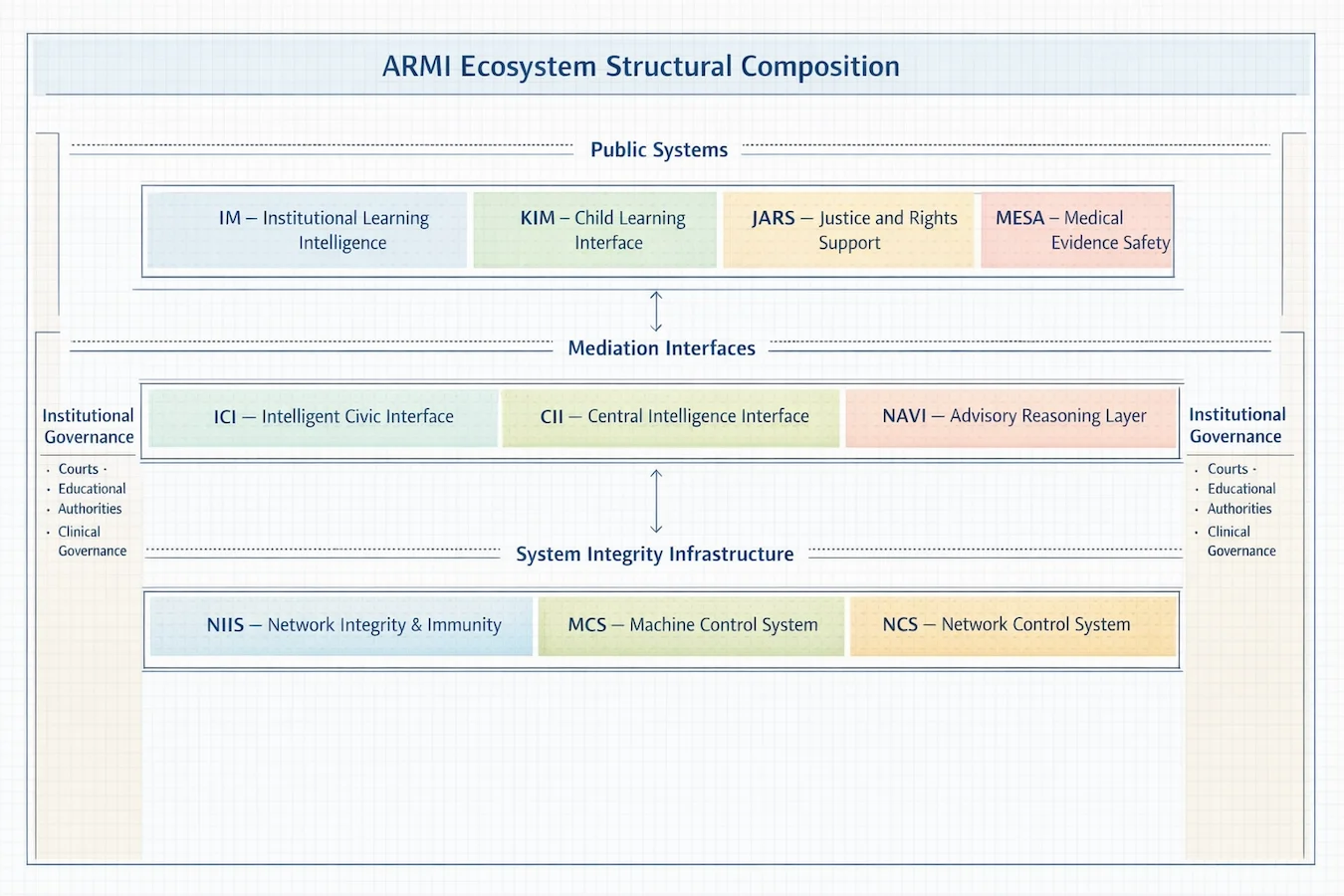
The ecosystem operates through layered architectural components. Public systems provide institutional capability, mediation layers govern civic interaction and advisory reasoning, while integrity infrastructure maintains execution stability and containment within institutionally governed environments.
Foundational Characteristics
Distributed across jurisdictions
Institutionally anchored
Governance-bound at the local level
Coordinated through shared structural standards
Non-centralized by design
The ecosystem scales through replication of structure — not concentration of power.
No supranational intelligence core governs participating systems. No centralized authority overrides institutional decision-making.
Instead, each region operates its own bounded implementation of Public Systems and System Integrity components under its lawful governance framework.
The result is a coordinated but sovereign public infrastructure network — aligned architecturally, independent institutionally.
Participating Domains
Human-facing system domains within each jurisdiction
Within each participating region, the ecosystem includes institutionally governed public systems operating under local authority and lawful oversight.
These domains are replicated structurally across jurisdictions while remaining governed locally.

MESA - Medical Evidence Safety Architecture
Medical evidence safety infrastructure supporting institutional review without diagnosing, prescribing, or directing care.
LEARN MORE →
JARS - Justice & Rights System
Justice and rights information support that assists understanding without adjudicating or exercising legal authority.
LEARN MORE →
IM - Intelligent Master
Structured learning and reasoning support for institutions and formal education environments.
LEARN MORE →
KIM - Kids Intelligent Master
Child-first learning environments governed by explicit adult authority and continuous supervision.
LEARN MORE →Structural Coordination
A Multi-Jurisdiction Structural Model
Within each participating jurisdiction, the ecosystem is implemented as a complete but bounded structural stack.
Public Systems, mediation interfaces, and System Integrity components operate locally under institutional governance.
International scaling does not introduce a superior command layer. It introduces structural compatibility across independent deployments.
Replicated Structural Units
Each jurisdiction maintains its own:
Civic Intelligence systems (IM, KIM, JARS, MESA)
Mediation layers (ICI, CII, NAVI)
System Integrity components (NIIS, MCS, NCS)
Governance and oversight institutions
These elements form a structurally complete unit.
When additional regions adopt the framework, they do not attach to a centralized intelligence core. They instantiate the same structural principles within their own lawful and institutional environments.
When the framework expands internationally, new regions do not attach to a central intelligence system. Instead, each jurisdiction instantiates a complete structural unit within its own governance environment while remaining architecturally compatible with others.
View multi-jurisdiction ecosystem model
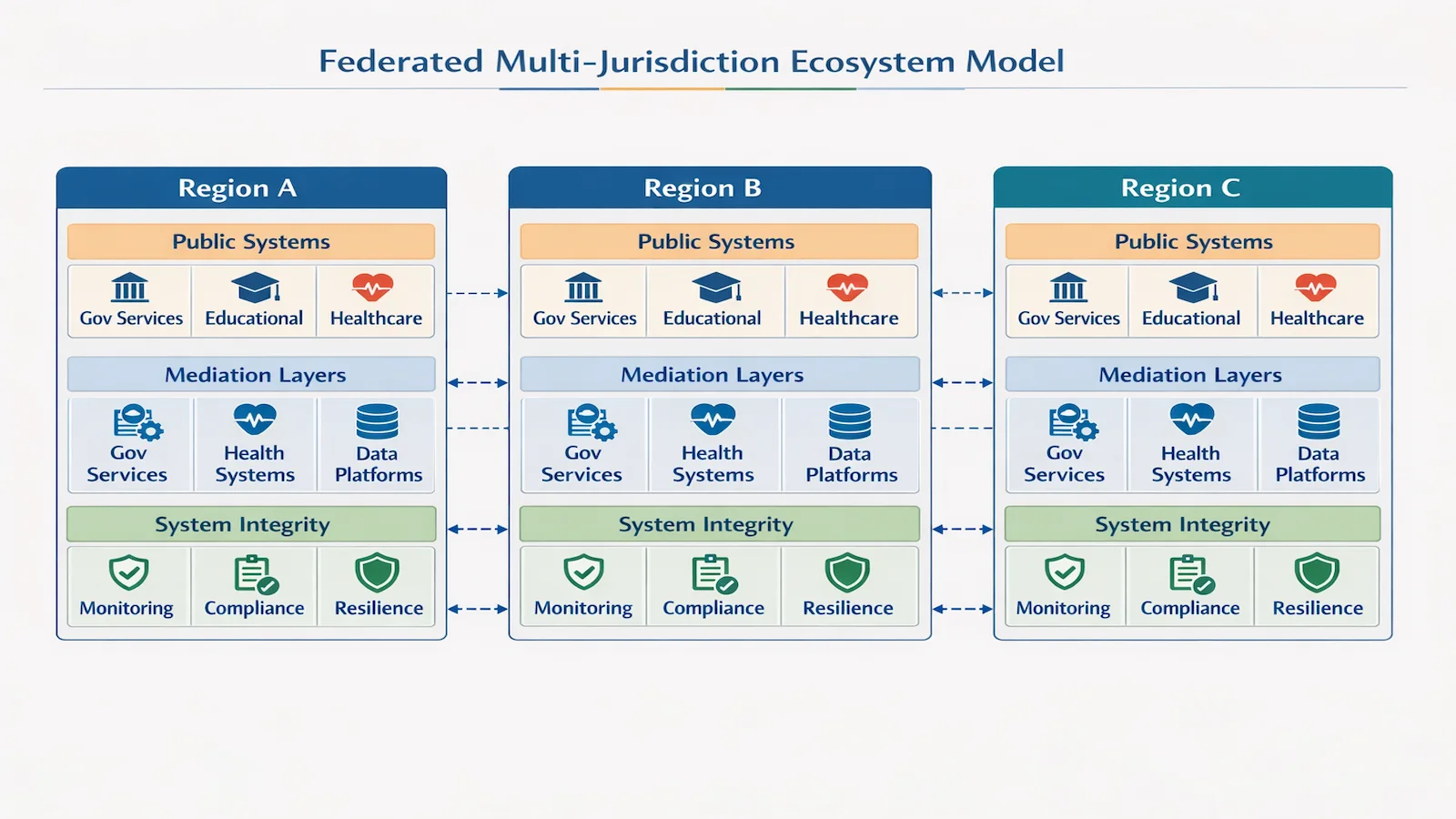
Federated ecosystem model showing structurally aligned but institutionally independent jurisdictional deployments. Coordination occurs through shared architectural standards — not centralized authority.
Coordination Without Consolidation
Structural compatibility enables shared safety standards, audit methodologies, research collaboration, and technical interoperability.
It does not merge authority across borders.
Governance remains local
Authority remains jurisdictional
Oversight remains institution-specific
Execution remains regionally contained
The ecosystem therefore expands horizontally across jurisdictions, rather than vertically into a centralized command structure.
Each region retains operational autonomy while benefiting from architectural alignment and shared structural discipline.
Interoperability Model
Cross-Border Coordination Without Centralization
As the ecosystem expands across jurisdictions, coordination becomes necessary — but centralization does not.
Participating regions may align on shared structural standards, safety practices, research methodologies, and technical protocols.
This alignment enables interoperability while preserving sovereign authority.
Interoperability Without Authority Transfer
Cross-border cooperation occurs through institutional coordination rather than through centralized system control. Architectural compatibility enables collaboration while preserving jurisdictional authority boundaries.
Shared architectural principles
Shared interface standards
Shared audit frameworks
Shared safety benchmarks
These common elements allow systems in different jurisdictions to communicate, collaborate, and learn from one another.
They do not create a supranational command layer.
The relationship between jurisdictions can be visualized as a coordinated but non-centralized network. Each region maintains its own institutional systems while collaborating through shared research, safety practices, and interoperability standards.
View cross-border coordination model
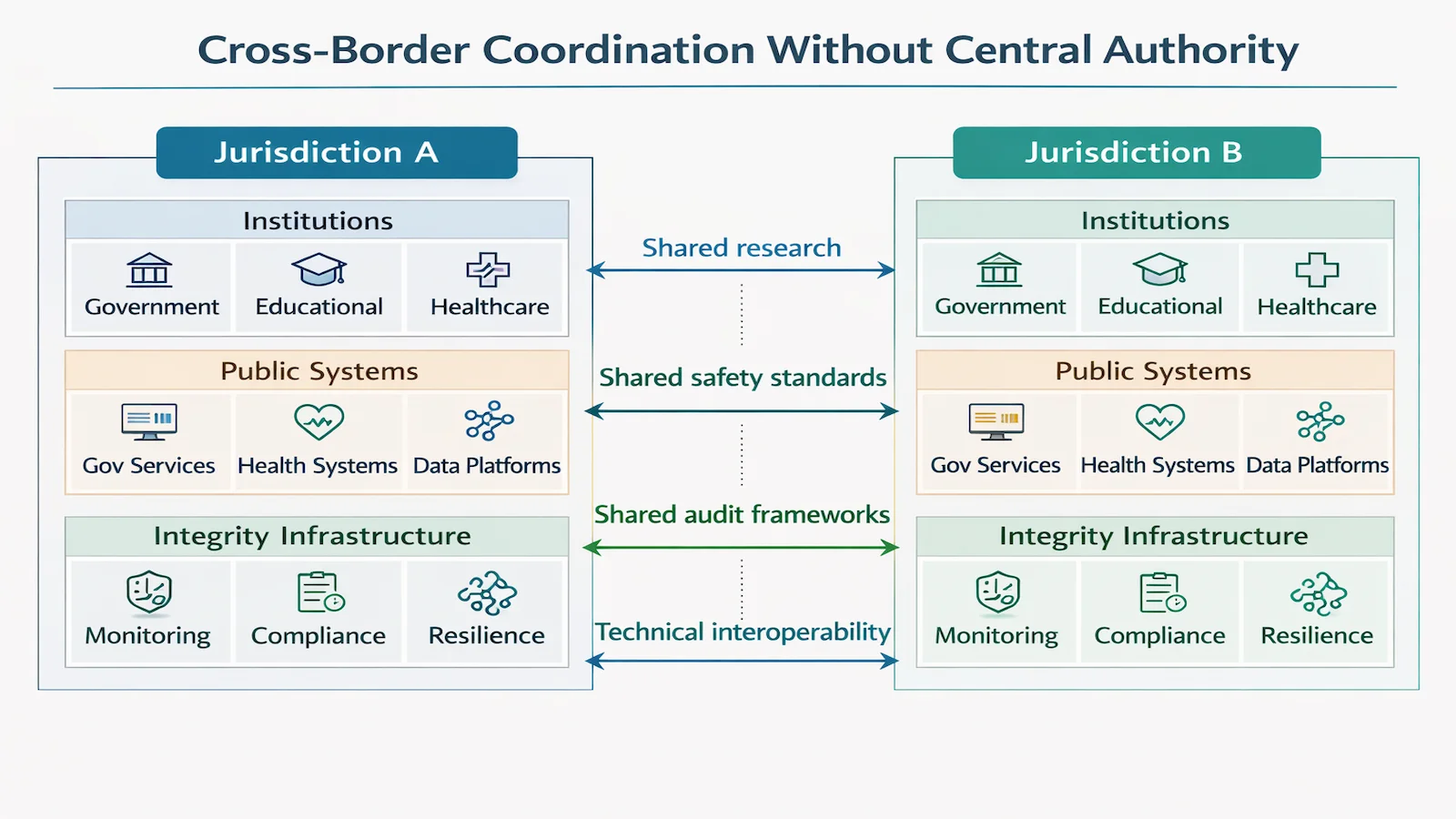
Cross-border coordination occurs through shared standards, collaborative research, and institutional agreements rather than through centralized system authority. Each jurisdiction maintains independent governance and operational control while remaining architecturally compatible with others.
Modes of International Coordination
Cross-border coordination may occur in several structured forms:
Collaborative research across educational institutions
Shared medical evidence standards across clinical systems
Rights-awareness model alignment across justice environments
Infrastructure resilience knowledge exchange across integrity systems
In each case, collaboration operates through institutional agreements — not through centralized technical control.
No jurisdiction may directly invoke execution authority within another.
Preserved Structural Boundaries
Cross-border data exchange, where permitted by law, remains subject to:
Local governance approval
Institutional oversight
Role-based access controls
Audit and traceability requirements
Integrity systems remain regionally contained. Civic systems remain institutionally anchored.
Architectural compatibility enables cooperation. It does not dissolve jurisdictional separation.
Horizontal Expansion Principle
The ecosystem expands horizontally across borders.
It does not consolidate vertically into global authority.
Each region participates as a structurally aligned but institutionally independent node within a federated network.
Coordination strengthens capability. Sovereignty preserves legitimacy.
Sovereign Governance
Institutional Anchoring and Local Authority
The ARMI ecosystem does not operate above institutions. It operates through them.
Each jurisdictional implementation is formally anchored within recognized public institutions and lawful governance frameworks.
Architectural alignment provides structural consistency. Institutional anchoring provides legitimacy.
Institutional Anchor Points
Within each participating region:
Educational authorities govern IM deployments
Guardians and institutions oversee KIM environments
Courts and legal institutions anchor JARS systems
Clinical governance bodies supervise MESA coordination
Infrastructure administrators control NIIS, MCS, and NCS components
These institutions define scope, permissible use, oversight requirements, and escalation pathways.
The ecosystem cannot self-authorize. It cannot self-expand authority. It cannot override institutional mandate.
Governance Remains Jurisdictional
No global governance body supersedes national or regional authority.
Each deployment remains subject to:
Local law
Regional regulatory frameworks
Institutional review boards
Public accountability mechanisms
Cross-border collaboration does not dilute sovereign control.
Governance decisions originate within the jurisdiction in which systems operate, and authority does not migrate upward through architectural alignment.
Legitimacy Through Institutional Rooting
Public digital infrastructure derives legitimacy from lawful institutions, not from technical capability.
The ecosystem therefore remains:
Institution-led
Governance-bound
Regionally accountable
Structurally constrained
International alignment strengthens standards. Institutional anchoring preserves democratic authority.
Long-Horizon Continuity
Scaling Through Replication, Not Centralization
The ARMI ecosystem is designed to expand without consolidating authority.
Growth occurs through replication of structural principles within new jurisdictions — not through absorption into a central system.
Each additional region establishes its own institutionally anchored implementation while adhering to shared architectural standards.
Horizontal Scaling Principle
New jurisdictions adopt the framework locally
Governance remains sovereign
Execution remains regionally contained
Mediation layers enforce separation
No global command layer emerges
Scaling therefore increases participation without concentrating power.
View replicated ecosystem unit
Each participating region implements a complete structural unit of the ecosystem. Public systems operate within local institutions, mediation layers govern civic interaction, and integrity systems maintain execution stability under jurisdictional authority.
Distributed Resilience
Because the ecosystem is federated, failure or disruption in one jurisdiction does not compromise the entire network.
System Integrity components remain locally bounded. Governance decisions remain region-specific. Civic systems operate within defined institutional contexts.
This structural distribution strengthens long-term stability.
No single point of authority
No single execution core
No cross-border enforcement cascade
No architectural dependency on centralized control
Long-Horizon Public Infrastructure
The ecosystem is designed for generational continuity.
Institutional turnover, technological change, or regional expansion do not alter its core structural principles.
Architecture remains constant. Governance remains sovereign. Authority remains human.
Ecosystem Integrity
Coordination without consolidation
Alignment without authority transfer
Expansion without centralization
Continuity without power accumulation
The ARMI ecosystem operates as a network of aligned institutions — structurally compatible, institutionally independent, and permanently bound to local governance.