

System Integrity · Situational Intelligence
NAVI
System navigation & coordination
A bounded intelligence layer that synthesizes cross-system signals, supporting institutional awareness without executing action.
ADVISORY INTELLIGENCE · STRUCTURAL AWARENESS · NON-EXECUTIVE
System Role
What NAVI is
NAVI functions as the interpretive navigation layer within the ARMI environment. It supports human and institutional users in understanding complex system landscapes, surfacing context, dependencies, and structured relationships across public infrastructure domains.
NAVI is not an executive system. It does not deliver outcomes, issue decisions, or operate public-facing authority. Its role is explanatory: helping institutions remain oriented inside complexity while preserving clear boundaries of responsibility.
By providing synthesis and situational legibility, NAVI strengthens coherence across systems without collapsing distinctions between advice, governance, and action. Intelligence remains supportive, not directive.
NAVI is intentionally bounded within the System Integrity architecture. It operates under constitutional mediation and cannot bypass immunity rules, safety constraints, or institutional oversight pathways defined outside the layer itself.
In this way, NAVI contributes to long-horizon public trust: improving understanding while ensuring that authority remains human, institutional, and accountable over time.
NAVI is designed to remain exploratory rather than prescriptive. It helps map conditions and pathways without substituting for judgment, and it remains structurally incapable of autonomous execution.
Functions
Core functions
NAVI’s functions are designed to support institutional understanding inside complex public-system environments. The layer exists to provide orientation, interpretive clarity, and structured synthesis without substituting for judgment or collapsing uncertainty into authority.
NAVI does not operate the systems it describes. Its contribution is explanatory: helping institutions see how components, processes, and options relate in practice, and making technical and procedural relationships more legible for human review and deliberation.
Within this bounded role, NAVI may surface dependencies, alternatives, and possible sequences of consideration, supporting coherent navigation across domains where public systems intersect. It does so without prescribing action, directing outcomes, or merging reasoning with executive authority.
All outputs remain reviewable, institution-first, and structurally non-executive. NAVI is a navigation layer: informative by design, constrained by governance, and limited by the integrity architecture in which it operates.
The structure below illustrates how NAVI organizes interpretive reasoning before information returns to institutional review. Each step represents contextual synthesis rather than decision authority.
View navigation intelligence structure
While the stack above describes NAVI’s internal reasoning stages, the diagram below illustrates how these interpretive processes help institutions explore relationships across complex system environments.
View reasoning pathway diagram
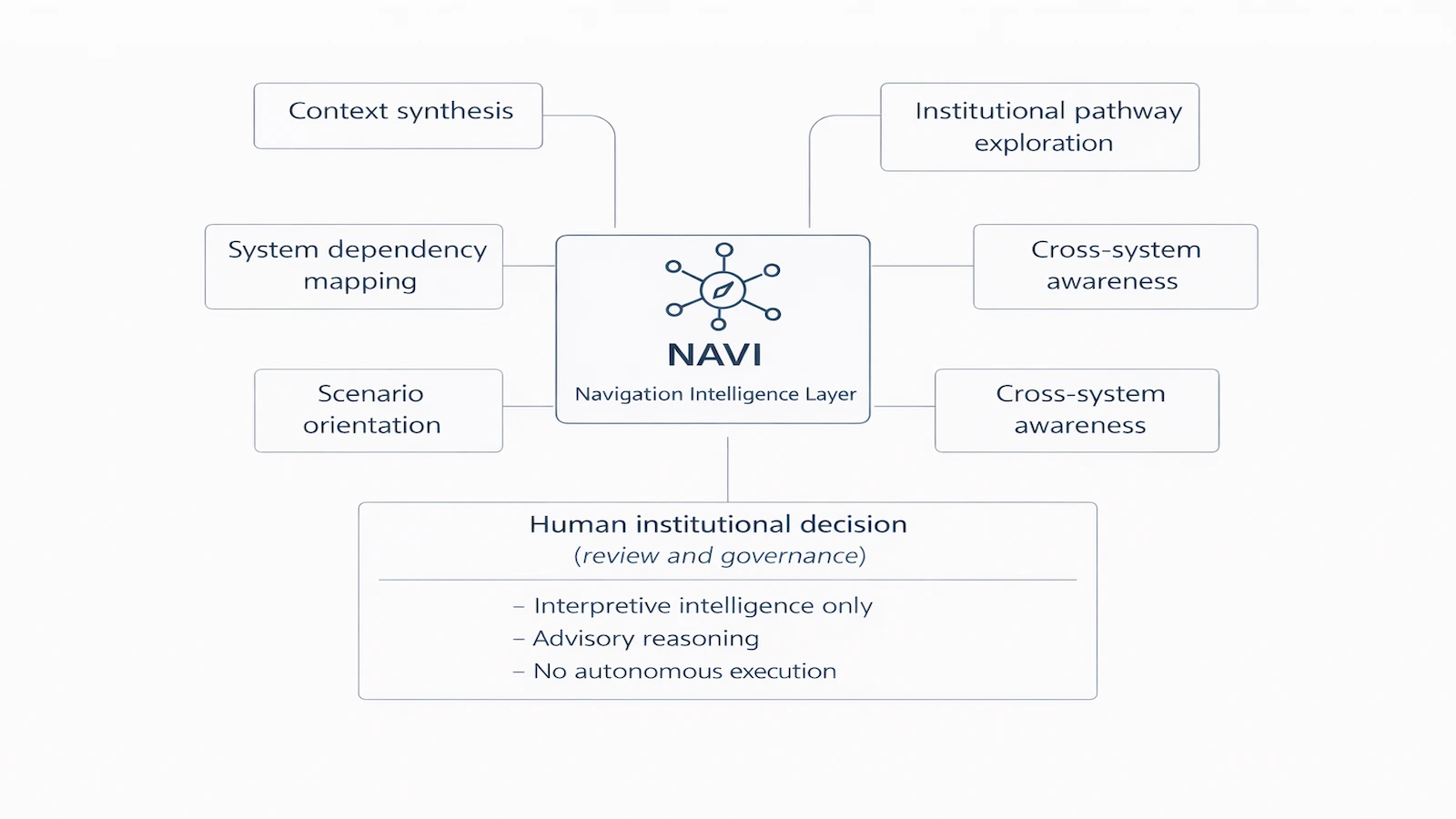
NAVI synthesizes contextual signals across systems, explores possible reasoning pathways, and presents structured explanations for institutional review. The layer supports orientation and understanding but does not generate decisions or initiate execution within the architecture.
In practice, these functions allow institutions to explore complex conditions without transferring responsibility away from human judgment. NAVI remains a support layer for understanding and orientation, ensuring that interpretation strengthens governance rather than replacing it.
System Interface
Relationship to CII
NAVI operates through the Central Intelligence Interface (CII), which serves as the constitutional mediation layer between interpretive intelligence and the wider ARMI system environment. NAVI does not couple directly to execution layers or public systems, and it does not function as a free-standing assistant within the architecture.
CII defines the interaction boundary through which contextual reasoning may be exchanged. This boundary is structural rather than discretionary: it preserves separation of roles, prevents implicit system entanglement, and ensures that interpretive intelligence remains bounded to navigation and explanation rather than authority or control.
The interaction pathway between civic systems, constitutional mediation, and interpretive intelligence can be visualized as a layered exchange structure. Requests originating from civic interfaces pass through CII, where mediation and boundary enforcement occur before contextual reasoning reaches the navigation layer.
View CII mediation pathway
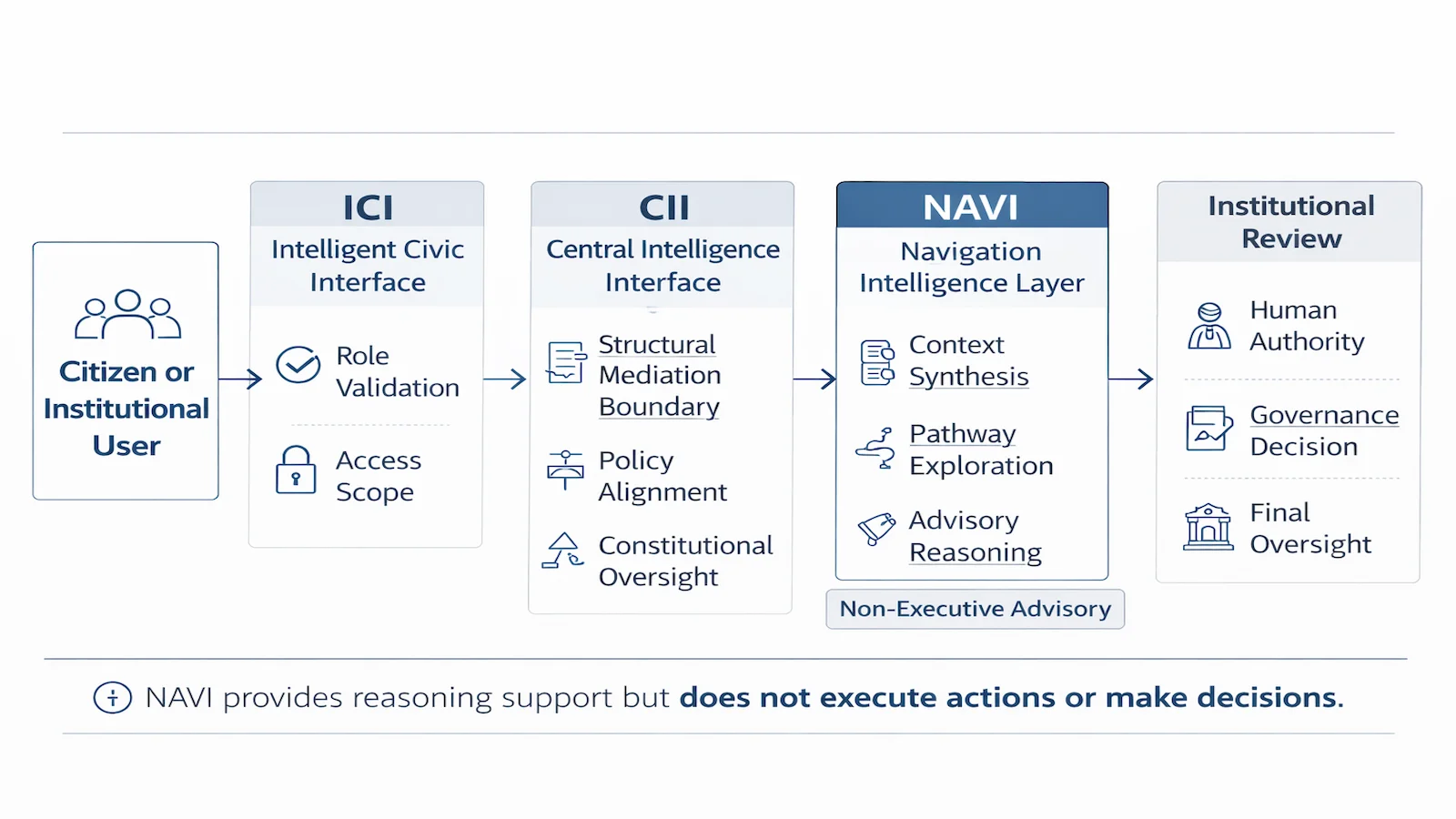
Civic interaction flows through the Intelligent Civic Interface (ICI) before entering the Central Intelligence Interface (CII), where constitutional mediation and boundary enforcement occur. Only after this mediation does contextual reasoning reach NAVI, ensuring that interpretive intelligence remains advisory and separated from execution authority.
By routing interaction through CII, NAVI’s outputs remain observable and institutionally reviewable. Exchanges occur through explicit interfaces, within governed pathways, so that institutions retain the ability to examine, challenge, pause, or redirect reasoning under real operational conditions.
This interface-based design also protects long-horizon stability. NAVI may evolve in explanatory depth and clarity over time, but the authority relationships of the architecture do not drift. Governance remains where it belongs, execution remains separately constrained, and intelligence remains supportive.
Ecosystem
NAVI within the DIPA Ecosystem
Within this ecosystem, NAVI is intentionally limited to interpretation, synthesis, and contextual guidance. It does not execute actions, enforce outcomes, or operate as an autonomous system. Its role is to clarify structure, relationships, and reasoning paths for human decision-makers.
All interaction involving NAVI flows through the Intelligent Civic Interface (ICI), which serves as the shared civic-facing layer across systems such as IM, KIM, and JARS. NAVI itself is not a civic system and is not directly accessed by the public.
The Intelligent Civic Interface (ICI) is governed by the Central Intelligence Interface (CII). CII does not interact with NAVI as a user-facing system. Its role is to enforce structural boundaries between civic systems and any coordination, control, or execution layers.
The relationship between these layers can be visualized as a structured separation of civic interaction, constitutional mediation, and interpretive intelligence. NAVI remains positioned behind the civic interface layer, operating only within governed pathways defined by the DIPA architecture.
View NAVI ecosystem architecture
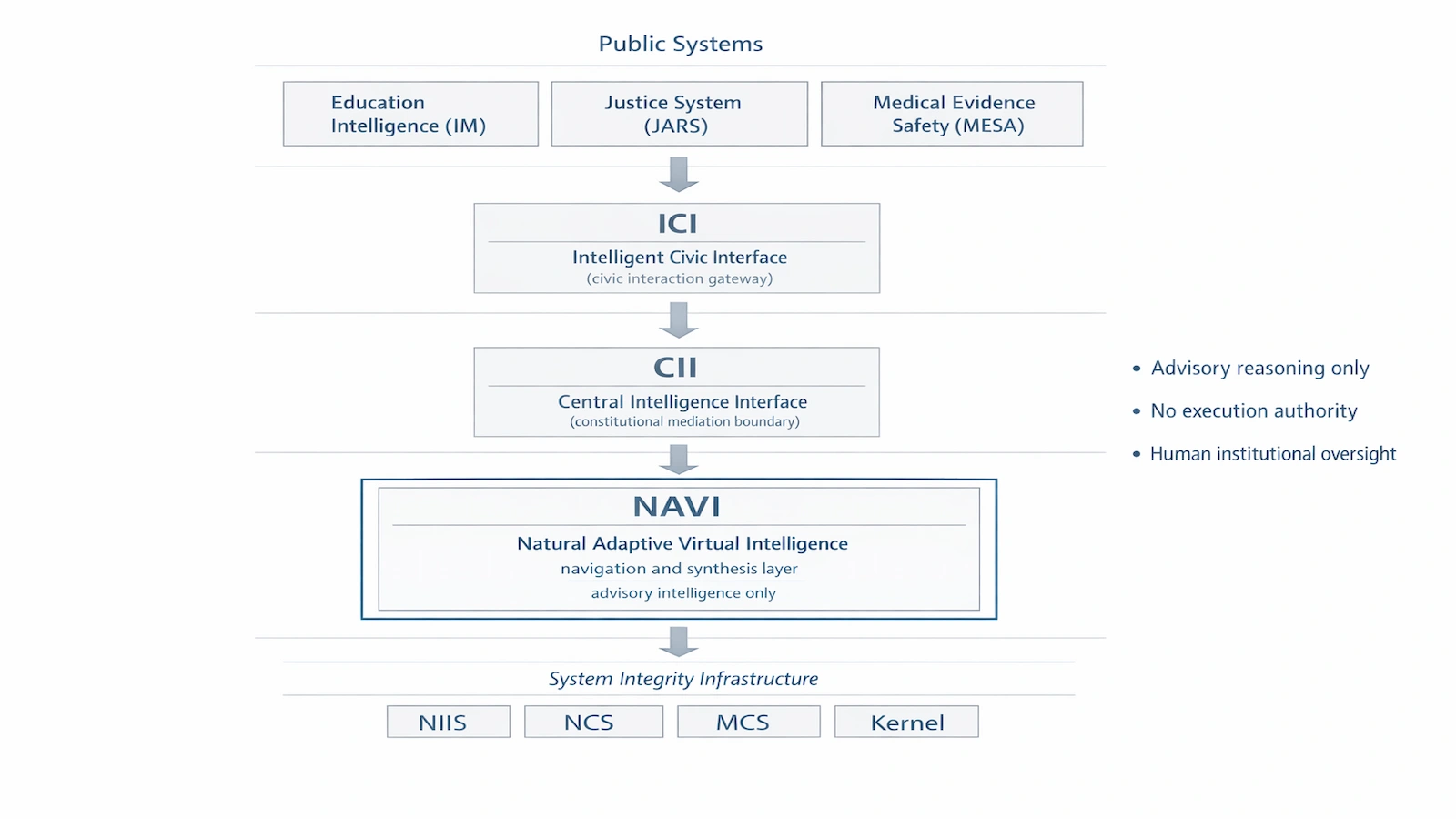
NAVI operates behind the civic interaction layer within the governed DIPA architecture. Civic requests pass through ICI and constitutional mediation via CII before reaching interpretive intelligence layers. Execution authority and operational control remain separated within the system integrity infrastructure.
Beneath CII sit infrastructure and continuity systems responsible for boundary enforcement, containment, and operational stability. These systems have no awareness of interpretation, reasoning context, or civic meaning.
This layered separation ensures that NAVI remains a connective and interpretive layer. It can evolve its reasoning and explanatory methods without altering legal responsibility, authority boundaries, or enforcement mechanisms across the architecture.
By embedding NAVI within this governed architecture, DIPA ensures that interpretation and navigation remain accountable, reviewable, and aligned with institutional responsibility.
Framework
Institutional context
NAVI is defined within the governing DIPA framework and operates behind the civic-facing interface layer (ICI).
DIPA FRAMEWORK → ICI INTERFACE LAYER →Publications
NAVI Documents & References
NAVI Whitepaper
Navigation intelligence scope and coordination boundaries.
NAVI Research Papers
Formal research on governance-aligned navigation systems.
Full Document Library
Browse all official NAVI and ARMI publications.
EXPLORE →Research & Analysis
Access research papers and analytical publications.
EXPLORE →System Integrity
Continue through the Integrity Layers
The systems below form the machine and infrastructure integrity layers of the ARMI architecture. They operate beneath civic interfaces to preserve execution boundaries, maintain operational stability, and ensure that technical systems remain constrained by institutional governance.
Each layer performs a distinct role within the integrity stack. Explore adjacent components of the architecture below.

NAVI
Situational synthesis and advisory reasoning.
LEARN MORE →
NIIS
Infrastructure immunity and systemic safety constraints.
LEARN MORE →
MCS
Deterministic machine execution governance.
LEARN MORE →
NCS
Network routing boundaries and isolation control.
LEARN MORE →
Guardian Switch
Sovereign isolation hard-stop for exceptional conditions.
LEARN MORE →
Kernel
Deterministic execution substrate with capability boundaries.
LEARN MORE →