
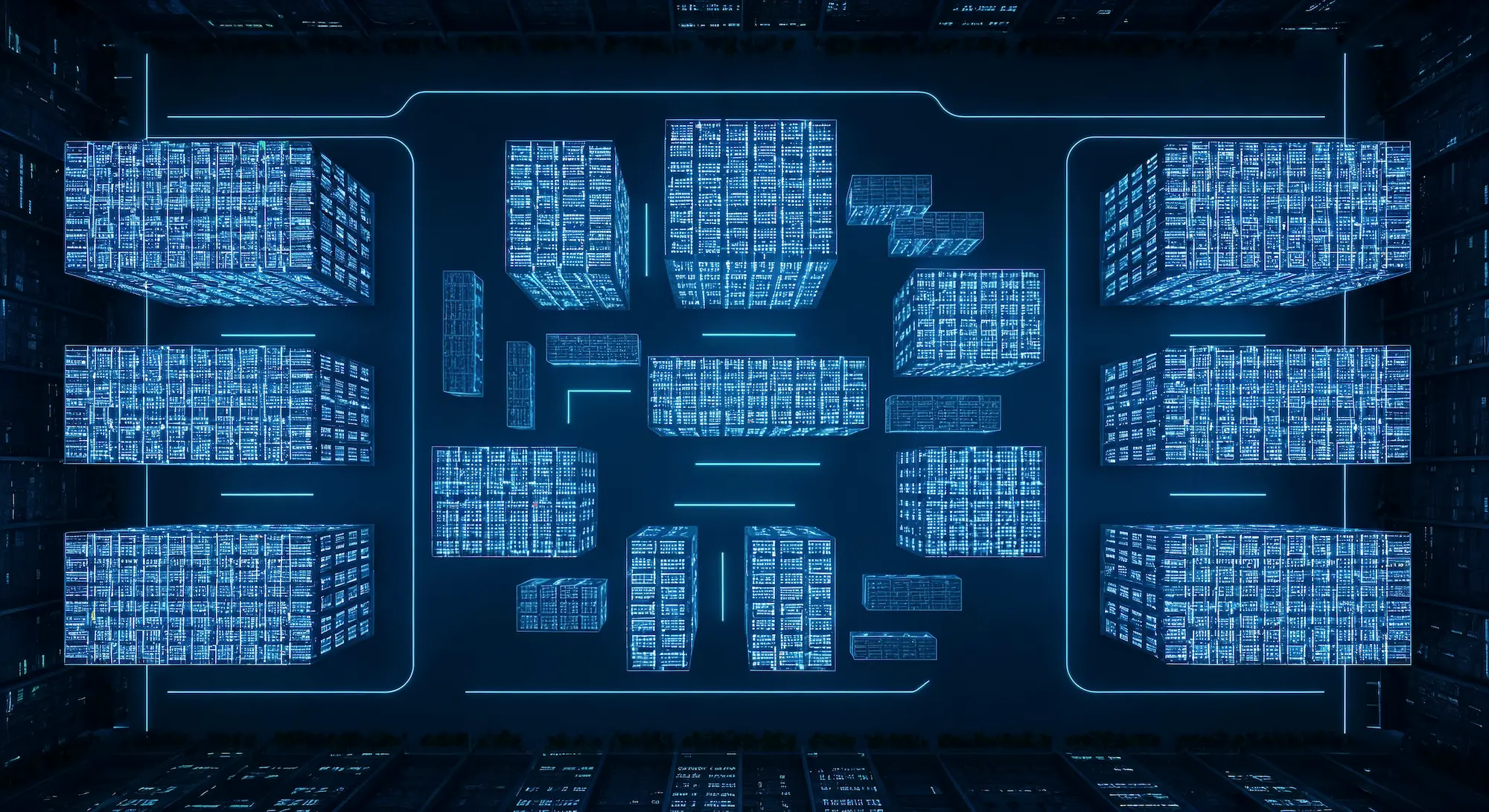
Definition
The Central Intelligence Interface
The Central Intelligence Interface (CII) is the boundary and mediation layer within the DIPA and ARMI architecture. Its role is to structurally separate public-facing systems, institutional authority, and technical execution layers, ensuring that interactions between these domains remain governed, reviewable, and constrained by design.
CII is not a user-facing system, not a decision-making system, and not an intelligence service. It exists solely to enforce separation of roles, prevent authority drift, and mediate how information, requests, and actions may cross between different layers of the architecture.
In this sense, CII functions as a constitutional layer of the infrastructure: it does not add capability or intelligence, but instead defines what is structurally permitted, what must be routed to human institutions, and what must be blocked or constrained by default.
This boundary role becomes easier to understand when examining how civic systems interact with the surrounding architecture.
View Boundary Architecture Diagram
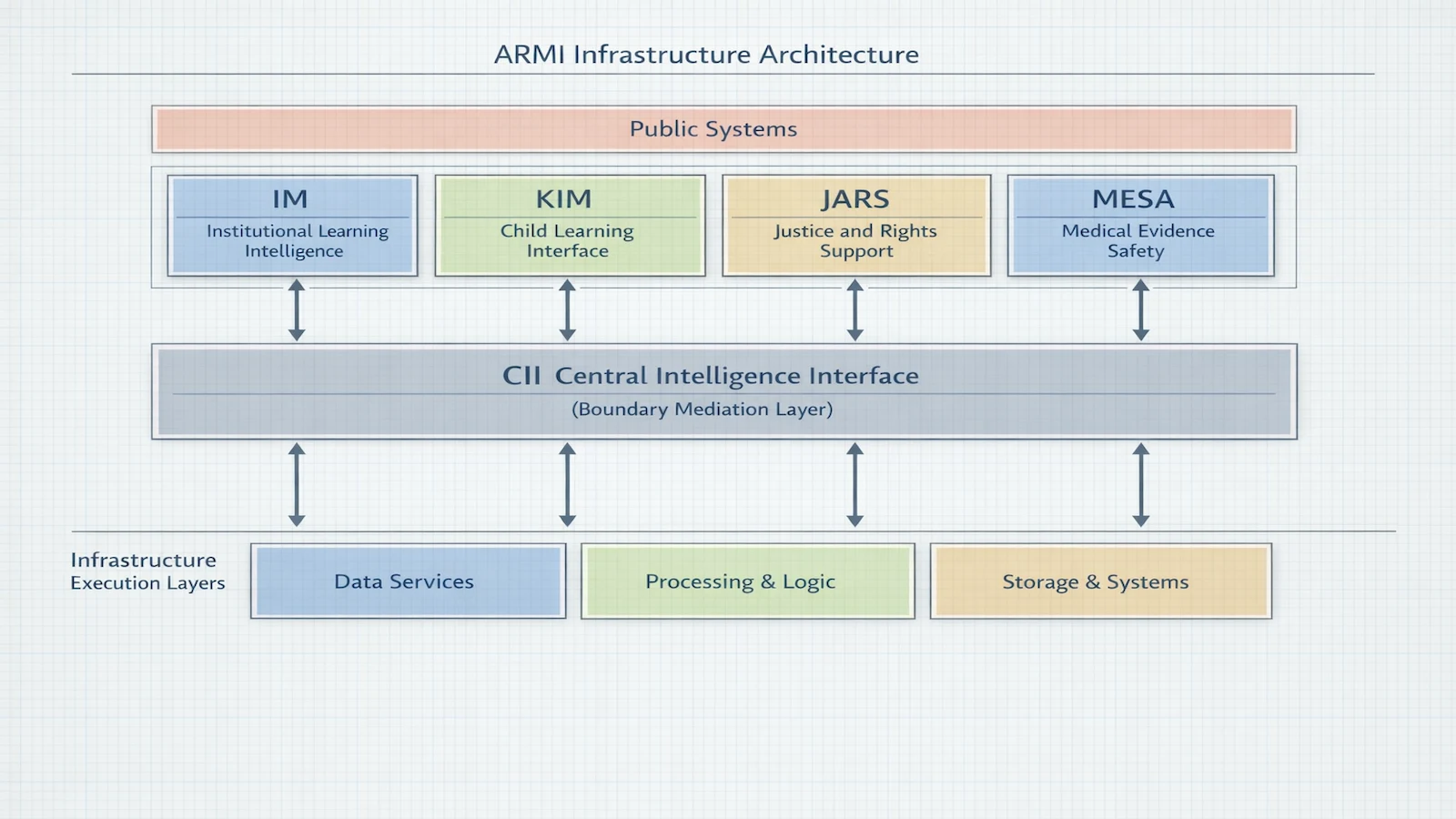
Boundary mediation separating civic interfaces, institutional authority, and technical execution layers.
Interface boundary
CII and the Intelligent Civic Interface (ICI)
The Central Intelligence Interface (CII) does not interact directly with civic systems such as IM, KIM, or JARS. All civic-facing systems operate exclusively through the Intelligent Civic Interface (ICI), which serves as the presentation and coordination layer for public and institutional interaction.
ICI structures communication between human users and civic systems, while CII governs what those systems are structurally permitted to request, route, or expose across the wider infrastructure.
In practical terms, the relationship follows a strict architectural order.
Civic systems
Systems such as IM, KIM, and JARS operate within the civic domain. They provide educational, justice, and public-service functionality, but they do not interact directly with infrastructure or execution layers.
The civic interface
The Intelligent Civic Interface (ICI) serves as the coordination layer for these systems. It structures how civic systems present information, accept requests, and communicate with the surrounding architecture.
The constitutional boundary
Beneath ICI sits the Central Intelligence Interface. CII governs what requests are structurally permitted to cross into deeper system layers and ensures that no civic interface can bypass architectural boundaries.
This ordered structure — Civic Systems → ICI → CII — forms the constitutional interaction pattern of the DIPA architecture.
Boundaries
What CII is not
Because the Central Intelligence Interface sits at a critical boundary between domains, it is important to define clearly what it cannot do and what it must never become.
No decision authority
CII cannot make, approve, or reject decisions. Decisions remain the responsibility of human institutions and authorized officials.
No legal interpretation
CII does not interpret law, evaluate cases, or determine legal outcomes. Judicial and institutional reasoning remain entirely human processes.
No observation of individuals
CII does not monitor people, profile behavior, or conduct surveillance of any kind.
No autonomous action
CII cannot initiate procedures, trigger institutional actions, or cause operational effects in civic or technical systems.
No accumulation of authority
The boundary layer cannot expand its role or acquire new powers without explicit institutional governance and review.
No hidden intelligence layer
CII is not an intelligence system, not a reasoning engine, and not a covert decision mechanism embedded within the architecture.
In short, CII is not a system of authority, intelligence, or control. It is a system of constraint.
Rationale
Why CII exists
Once the boundaries of the Central Intelligence Interface are understood, the question naturally follows: why is such a layer necessary in the architecture at all?
Large, complex technical systems tend to accumulate power over time. Even when originally designed as support tools, they often drift toward decision-making roles, authority, and operational control through gradual expansion of scope, convenience-driven shortcuts, or institutional dependency.
In civic, legal, and institutional contexts, this kind of drift is not merely a technical risk. It is a constitutional risk. It can undermine democratic accountability, judicial independence, and the separation between human authority and technical capability.
Policy rules and ethical guidelines alone are not sufficient to prevent this. Over long time horizons, systems must be constrained by structure, not by promises.
The Central Intelligence Interface exists to provide this structural constraint. It introduces a permanent boundary layer that makes certain kinds of drift physically and architecturally impossible without explicit human intervention and institutional approval.
The structural importance of this boundary becomes clearer when comparing architectures that lack such mediation with those that enforce it.
View Authority Drift Prevention Diagram

Boundary mediation preventing technical systems from accumulating institutional authority over time.
By enforcing a permanent boundary between civic authority and technical execution, CII ensures that infrastructure systems remain tools rather than actors within governance processes.
CII does not exist to make the system more powerful. It exists to make it permanently incapable of becoming powerful in the wrong way.
Architecture principle
The two worlds separation
The architecture is built around a fundamental separation between two distinct domains: the civic and institutional world, and the technical and execution world. Each operates under different rules, forms of authority, and accountability structures.
The civic and institutional world
This domain contains courts, ministries, public agencies, educators, and other human authorities. It is the domain where law is interpreted, decisions are made, and responsibility is carried.
The technical and execution world
This domain contains infrastructure systems, control layers, and operational mechanisms. It is where processes are executed, information is handled, and technical work is performed.
These two worlds must never merge. The Central Intelligence Interface exists as the only permitted crossing point between them. Even there, it does not unify the domains — it mediates, constrains, and records their interaction.
No authority flows downward into machines. No autonomous decision flows upward into institutions. All interaction is gated, mediated, and subject to human governance.
View Two-Worlds Architecture Diagram
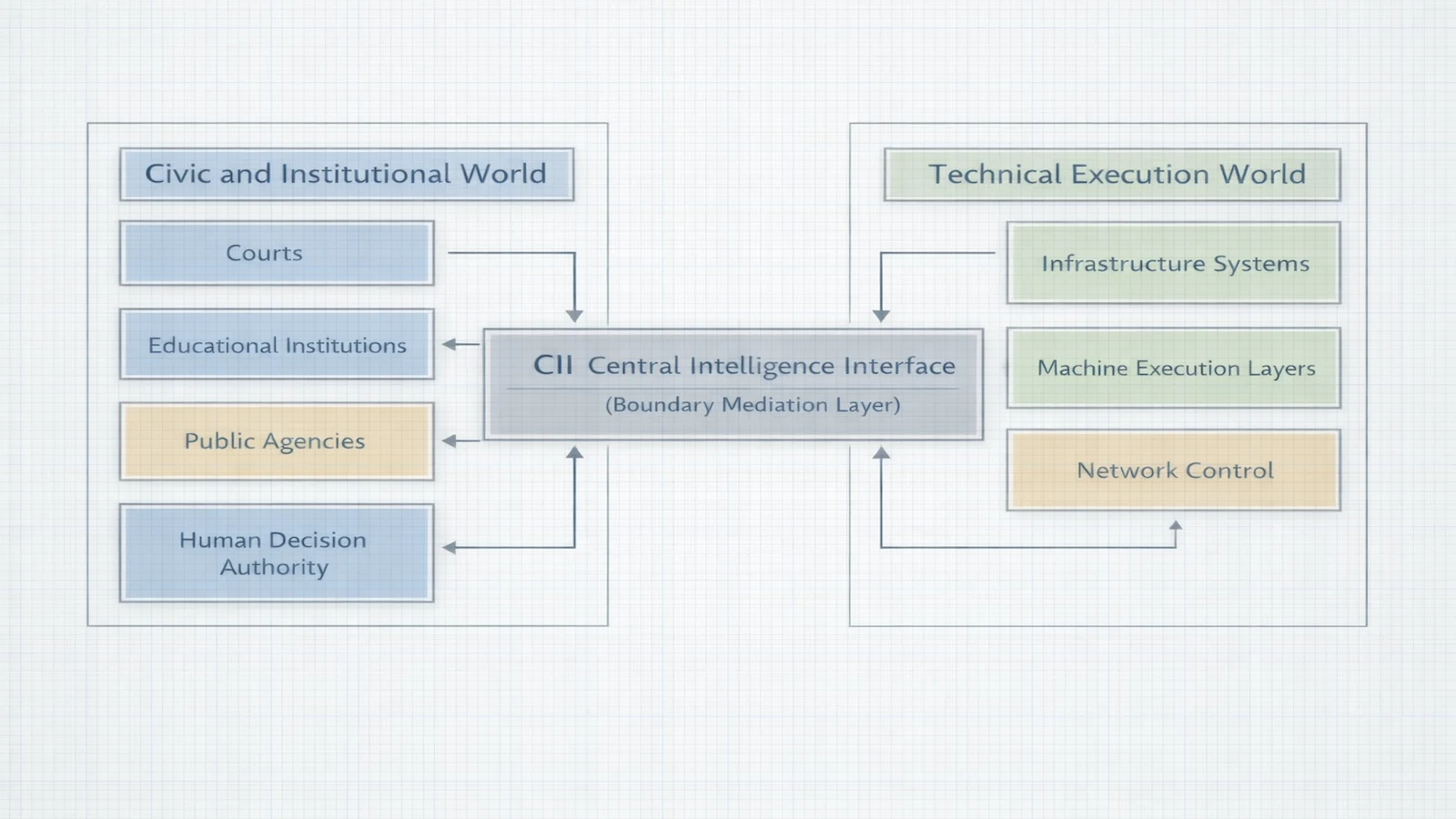
Civic authority and technical execution remain structurally separated, with CII acting as the mediation boundary.
CII does not connect these worlds. It ensures they can never collapse into one.
Function
What CII does (structurally)
The Central Intelligence Interface does not provide services or perform tasks in the conventional sense. Its role is structural: it defines how interactions between architectural layers are permitted, constrained, and mediated.
Rather than executing operations, CII defines the boundaries within which operations may occur.
Routing interactions
All permitted crossings between public interfaces, institutions, and execution infrastructure pass through CII. This ensures that interactions remain mediated and structurally governed.
Enforcing role boundaries
Components are prevented from accessing capabilities, information, or authority outside their defined scope within the architecture.
Blocking disallowed flows
Interactions that violate governance constraints or architectural separation rules cannot occur, because the structure itself prevents them.
Requiring human escalation
When an interaction enters the domain of institutional or legal authority, the path must exit the technical stack and return to human-controlled governance processes.
Preserving auditability
Cross-domain interactions are structured so they can be reviewed, audited, and governed over long time horizons.
CII does not add intelligence to the system. It removes dangerous degrees of freedom from the system.
Placement
CII in the system stack
The Central Intelligence Interface is not an application and not a service. It is a structural layer positioned between civic-facing systems and deeper infrastructure layers within the ARMI architecture.
Above the boundary
Immediately above CII sits the Intelligent Civic Interface (ICI), which is the sole layer permitted to communicate with the boundary system. Civic systems such as IM, KIM, JARS, the Justice Desk (JD), and the Rights Desk (RD) operate above ICI and never interact with CII directly.
Below the boundary
Beneath CII are the execution and infrastructure layers, including systems such as MCS, NCS, and NIIS. These layers focus on technical execution, operational control, and systemic reliability.
CII exists between these domains to ensure that no interpretive or access-facing system can directly control execution systems, and that no execution layer can ever become a source of institutional authority.
View Layered Stack Diagram
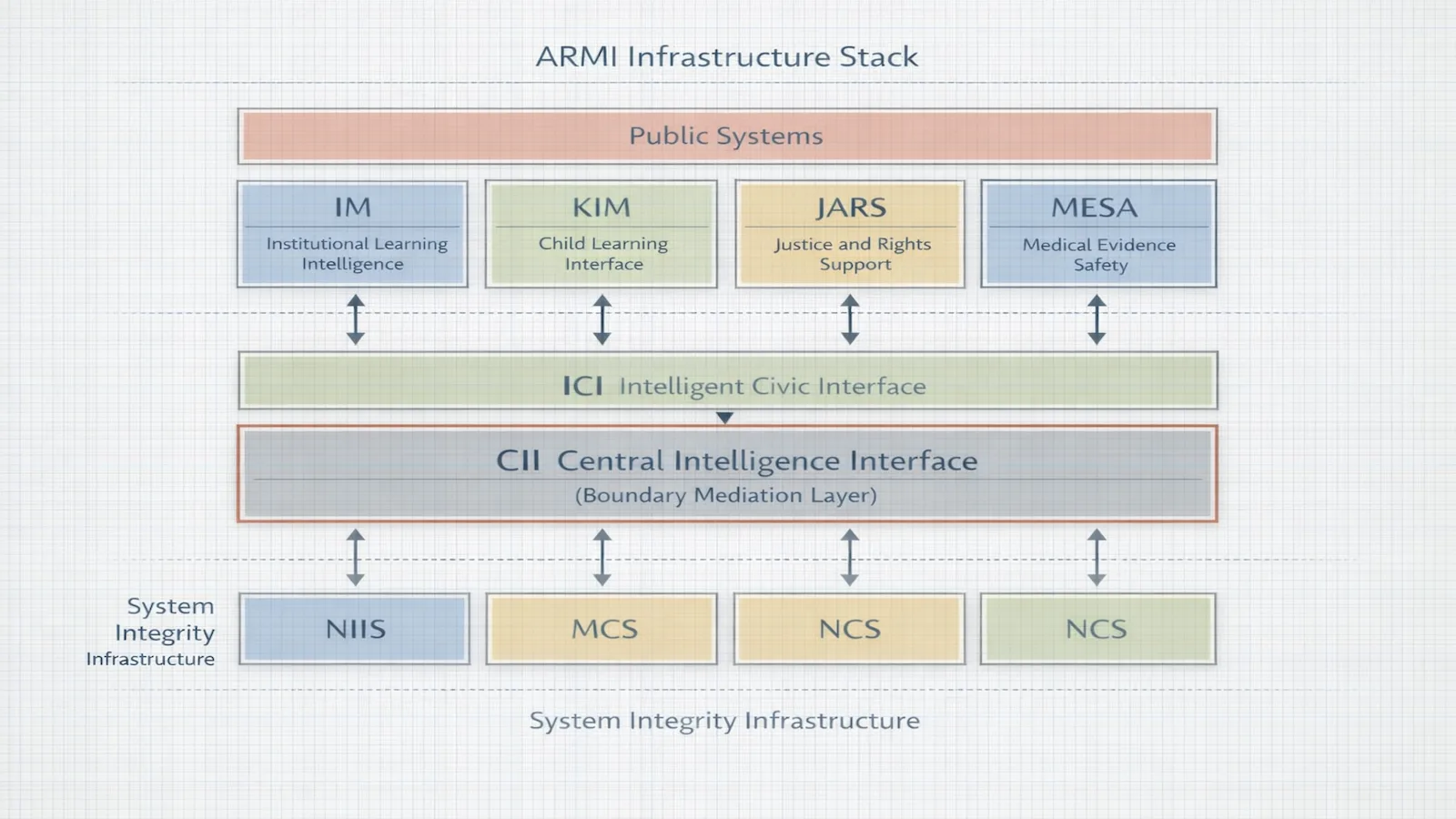
The system stack showing civic interfaces above, execution layers below, and CII acting as the structural boundary.
In this way, CII forms the permanent fault line of the architecture — the place where separation is enforced and authority cannot cross without human governance.
Control
Authority, governance & escalation
The Central Intelligence Interface does not hold or simulate authority. Its role is to ensure that authority remains where it legally and constitutionally belongs: with human institutions and their designated officials.
When an interaction crosses from technical or informational domains into institutional or legal authority, CII ensures that the path exits the technical stack entirely and enters a human governance process.
No technical approval
Technical systems cannot approve or validate actions that belong to institutional authority.
Mandatory human escalation
All interactions entering legal, enforcement, or governance domains must be routed to human-controlled processes.
Governance before expansion
Any change to what the architecture permits requires explicit institutional governance and review.
CII does not decide whether something is allowed. It decides whether something must be decided by humans.
This preserves the distinction between technical capability and legitimate authority as systems evolve over time.
System context
A shared boundary architecture
The previous sections describe how the Central Intelligence Interface preserves separation between institutional authority and technical execution. That boundary does not exist for a single system alone. It operates as a shared architectural layer across the broader DIPA and ARMI ecosystem.
Multiple public-interest systems rely on this boundary architecture. These systems operate in different domains — education, justice, medical safety, and infrastructure integrity — yet all interact with the surrounding architecture through the same mediated interface layer.
Systems such as MESA, the Justice and Rights Support System (JARS), the Intelligent Master (IM), the Kid Intelligent Master (KIM), and the Network Integrity & Immunity System (NIIS) all rely on CII to ensure that interactions between civic interfaces, institutions, and infrastructure layers remain structurally constrained.
In each case, CII performs the same architectural role: it prevents authority drift, enforces separation of domains, and ensures that technical capability remains subordinate to human and institutional governance.

MESA - Medical evidence safety
Medical evidence safety infrastructure preventing harm from fragmented clinical data.
EXPLORE HEALTH →
JARS - Justice & Rights Support
Justice and rights support framework operating within CII boundary governance.
EXPLORE JARS →
IM - Intelligent Master
Institutional learning intelligence operating under mediated civic interface controls.
EXPLORE EDUCATION →
KIM - Kid Intelligent Master
Child-focused learning system operating within protected civic boundaries.
EXPLORE EDUCATION →
NIIS - Network Integrity & Immunity System
Infrastructure immunity layer maintaining machine and network stability.
EXPLORE SYSTEM INTEGRITY →Oversight
Governance & institutional review
Because the Central Intelligence Interface defines the structural boundaries of the architecture, it cannot evolve informally or expand through technical iteration alone.
Its mediation scope, escalation rules, and separation constraints are subject to institutional governance and long-horizon public-interest oversight.
Boundary definitions
Oversight ensures that mediation rules remain explicit, stable, and institutionally governed rather than gradually expanding through technical convenience.
Separation of roles
Governance review verifies that civic systems, infrastructure layers, and institutional authority remain structurally distinct and that no component can accumulate cross-domain power.
Constitutional alignment
Oversight focuses on ensuring that legal responsibility, democratic accountability, and human decision authority remain intact across the entire architecture.
Long-term auditability
Cross-domain interactions must remain reviewable and accountable across decades of operation. Structural mediation ensures that system behavior remains transparent and subject to institutional scrutiny.
Governance does not focus on individual operational decisions. It focuses on whether the boundary architecture itself continues to protect the separation between technical capability and institutional authority.
Governance does not focus on individual operational decisions. It focuses on whether the boundary architecture itself continues to protect the separation between technical capability and institutional authority.
The architectural and governance principles behind CII are defined in formal specifications and research publications. Readers can access these materials in the reference section below, including technical specifications, architectural models, and the broader research and whitepaper libraries supporting the system integrity framework.
Reference
CII reference documents
The Central Intelligence Interface is defined through a set of formal architectural and governance documents. These publications describe the boundary architecture, mediation rules, and institutional role of CII within the broader ARMI and DIPA system framework.

CII — Boundary & Mediation Specification
Canonical definition of the CII boundary architecture.
OPEN DOCUMENT →
LCIM — Layered Civic Intelligence Model
Governance and execution separation model.
OPEN DOCUMENT →
Whitepaper Library
Browse all official architecture documents.
EXPLORE LIBRARY →
Research & Analysis
Analytical papers and system research.
EXPLORE RESEARCH →Together these documents define CII as a boundary architecture — ensuring that intelligence, execution, and institutional authority remain structurally separated within the ARMI system framework.
System Integrity
Continue through the Integrity Layers
The systems below form the machine and infrastructure integrity layers of the ARMI architecture. They operate beneath civic interfaces to preserve execution boundaries, maintain operational stability, and ensure that technical systems remain constrained by institutional governance.
Each layer performs a distinct role within the integrity stack. Explore adjacent components of the architecture below.
NAVI
Situational synthesis and advisory reasoning.
LEARN MORE →
NIIS
Infrastructure immunity and systemic safety constraints.
LEARN MORE →
MCS
Deterministic machine execution governance.
LEARN MORE →
NCS
Network routing boundaries and isolation control.
LEARN MORE →
Guardian Switch
Sovereign isolation hard-stop for exceptional conditions.
LEARN MORE →
Kernel
Deterministic execution substrate with capability boundaries.
LEARN MORE →Position
A boundary system, not a source of power
The Central Intelligence Interface is not the most capable or visible component in the architecture. It is the component that ensures no other component can ever become too capable in the wrong way.
It does not make the system smarter, faster, or more autonomous. It makes the system safer, more restrained, and more compatible with constitutional order and institutional governance.
By enforcing permanent separation between authority and execution, explanation and control, institutions and machines, CII ensures that public digital infrastructure remains a tool of human governance rather than a substitute for it.
In this sense, CII is not the center of the system. It is the line the system is not allowed to cross.