

Public Digital Infrastructure
Intelligence working
where institutions operate
ARMI conducts research and system design for long-term public digital infrastructure supporting education, justice, medical safety, and institutional coordination in environments where systems must remain reliable across decades of use.
The work focuses on how digital systems can support institutional processes, knowledge, and decision environments without replacing the responsibilities carried by public institutions themselves.
This research program begins with a simple question: what kinds of infrastructure are required for institutions operating under real public conditions.
Program scope
Building foundations for public digital infrastructure
ARMI is a research initiative focused on the design of long-term digital infrastructure for public institutions. The program develops architectural frameworks, system models, and technical foundations that support institutional environments such as education, justice, and public health.
The research examines how multiple layers of infrastructure operate together, civic interfaces, interpretive systems, machine execution layers, and institutional coordination structures, enabling complex public systems to remain understandable, reliable, and operational over long periods of time.
This work responds to conditions already visible across public institutions worldwide, where expanding scale, fragmented information environments, and growing procedural complexity place increasing pressure on existing systems.
Understanding those conditions is the starting point for the research program.
Measured conditions
Global civic conditions, measured over time
Across education, justice, and public health, institutions operate under pressures that have been documented for decades by international organizations and long-term research programs. These pressures provide the starting point for the infrastructure work described here.
Digital Infrastructure for Public Access (DIPA) begins with measured realities rather than speculative futures. The patterns described below reflect structural challenges that emerge when institutions operate at scale within increasingly complex and interconnected systems.
Observed across domains
Education - expanding global access while durable learning continuity remains uneven across systems and regions.
Justice - rising procedural complexity alongside widespread unmet legal needs across populations.
Public health - preventable harm linked to fragmented medical evidence and medication safety risks.
Education systems
Global access to education has expanded significantly in recent decades. However, learning outcomes remain uneven across regions, institutions, and social contexts. Longitudinal analysis by UNESCO distinguishes clearly between enrollment and durable learning continuity, demonstrating that access to schooling alone does not ensure sustained literacy, comprehension, or long-term educational stability.
Educational risk increasingly emerges from instability within the learning environment itself. Interruptions in schooling, inconsistent supervision, loss of educational context, and the absence of durable institutional support structures can disrupt learning continuity even where technology and connectivity are available. (UNESCO Global Education Monitoring Reports)
Justice systems
Justice systems experience a similar structural pattern. As awareness of rights expands globally, legal systems face increasing procedural complexity and rising institutional workload. United Nations reporting on access to justice indicates that billions of people experience unmet legal needs each year.
In many cases, law itself is not absent. Instead, lawful pathways become difficult to navigate, delayed, or practically inaccessible. Courts, registries, and legal aid systems often operate under sustained workload pressures that exceed their capacity to provide timely and understandable access at scale. (UN SDG 16 – Peace, Justice and Strong Institutions)
Public health and medical safety
Public health systems exhibit a parallel structural condition. Despite major advances in medical science, preventable harm remains widespread, particularly in medication safety and treatment coordination.
Global research shows that a significant share of medical injury arises not from incorrect diagnosis, but from fragmented evidence environments after diagnosis occurs. Laboratory data, imaging results, pharmacological knowledge, and patient records are often stored and interpreted across disconnected systems.
Under time pressure, clinicians must reconcile evolving medical evidence, drug interactions, and patient context across these fragmented information environments. (WHO – Medication Without Harm)
MESA (Medical Evidence Safety Architecture) responds to this measured condition by supporting the integrity and reconciliation of medical evidence before clinical decisions occur. Its role is not diagnostic or prescriptive. Instead, it preserves traceability across laboratory data, imaging evidence, and medication chemistry so clinicians retain clearer visibility across evolving evidence.
Digital infrastructure environments
These structural pressures extend beyond individual institutional domains. The digital infrastructure that supports cities, institutions, and public services has become deeply interconnected. Buildings, networks, devices, and machine systems now operate continuously across transportation, energy systems, communication networks, and critical services.
As these environments expand, reliability depends not only on performance but also on how consistently systems behave under changing conditions. Small inconsistencies can propagate quickly across connected networks, making it difficult to maintain stability, trace operational behavior, or coordinate responses across systems at scale.
Research increasingly identifies these challenges as systemic, emerging from the complexity of interconnected digital systems rather than isolated technical failures. (World Economic Forum – Global Cybersecurity Outlook)
Within this context, system integrity becomes a foundational requirement. Infrastructure must ensure that machine execution, network coordination, and system behavior remain predictable, observable, and consistent as scale increases.
Measured reality
Education - persistent gaps between access and durable learning outcomes. UNESCO
Justice - rising procedural complexity and unmet legal needs across populations. UN SDG 16
Health - preventable harm linked to fragmented medical evidence and medication safety risks. WHO
Digital infrastructure - interconnected systems where small inconsistencies can propagate across networks and services at scale. World Economic Forum
Across these domains, a shared structural pattern emerges. Systems are not failing independently. They are becoming increasingly interconnected, complex, and difficult to coordinate within existing institutional structures.
Purpose
Why this infrastructure exists
Within institutions, the conditions outlined earlier no longer remain external. They settle into everyday practice. Schools, courts, hospitals, and public agencies now carry layers of coordination and complexity that extend beyond their original design, increasingly supported by intelligent systems working alongside them.
As this shift progresses, intelligence begins to take a more active place within institutional environments. It shapes workflows, informs reasoning, and organizes knowledge at scale. Within this movement, a central question begins to take form: how can intelligence support institutional work while responsibility remains clearly held?
In practice, many institutions now rely on advanced systems to assist with analysis and coordination. As these systems expand in agencies and jurisdictions, they bring increased capability while gradually redistributing how responsibility is experienced within time and structure.
From this point, the need begins to clarify. What is required is durable public-interest infrastructure, a shared structural layer through which intelligence operates in continuity with institutional boundaries and public oversight.
Digital infrastructure for public access (DIPA) takes shape as that foundation. It supports how intelligence enters institutional life while remaining visible, reviewable, and anchored within the environments that carry civic responsibility. Over time, it becomes part of a architecture, sustaining continuity, legitimacy, and steady public use across generations.
It is an infrastructure layer, one that must be designed to operate within institutions, alongside existing processes, and within extended periods of time.
Design approach
How this infrastructure is designed
As this foundation begins to take shape within institutional environments, its design follows the conditions it is meant to support. Public and institutional settings require continuity, clarity, and responsibility to remain intact as systems are introduced and sustained over time. Within this context, design decisions settle around long-term operability, where systems remain dependable across extended use.
In these environments, intelligence enters alongside established processes, supporting human judgment while remaining understandable to those responsible for its operation and outcomes. Oversight forms part of the structure itself: role clarity, review pathways, and escalation boundaries take shape within the architecture, allowing authority to remain visible and institutionally anchored.
DIPA continues to develop as enduring public digital infrastructure, a stable civic foundation that institutions can rely on, adapt to, and sustain across decades. It operates in continuity with existing legal frameworks, professional norms, and institutional responsibilities, strengthening coherence as it becomes part of ongoing institutional work.
Through this approach, intelligence is introduced gradually, reviewed continuously, and adapted in step with evolving institutional needs. Adoption unfolds in a way that remains legible and steady over time, allowing systems to integrate without disruption while maintaining institutional continuity.
Together, these design commitments shape how intelligence supports education, justice, health, and essential public systems, remaining aligned with civic responsibility, sustaining continuity over time, and becoming compatible with public use.
These design principles take form through operational systems. They are structured into distinct layers, each serving a different role within the overall infrastructure.
Architecture overview
System map of the public infrastructure
The infrastructure is organized as a layered environment designed for long-term institutional use. Public systems operate as the human-facing layer, while deeper infrastructure maintains system coordination, integrity enforcement, and operational stability.
These layers remain connected through a shared architectural foundation that allows institutions to operate independent systems while remaining part of a coherent public digital environment.
View the infrastructure system map
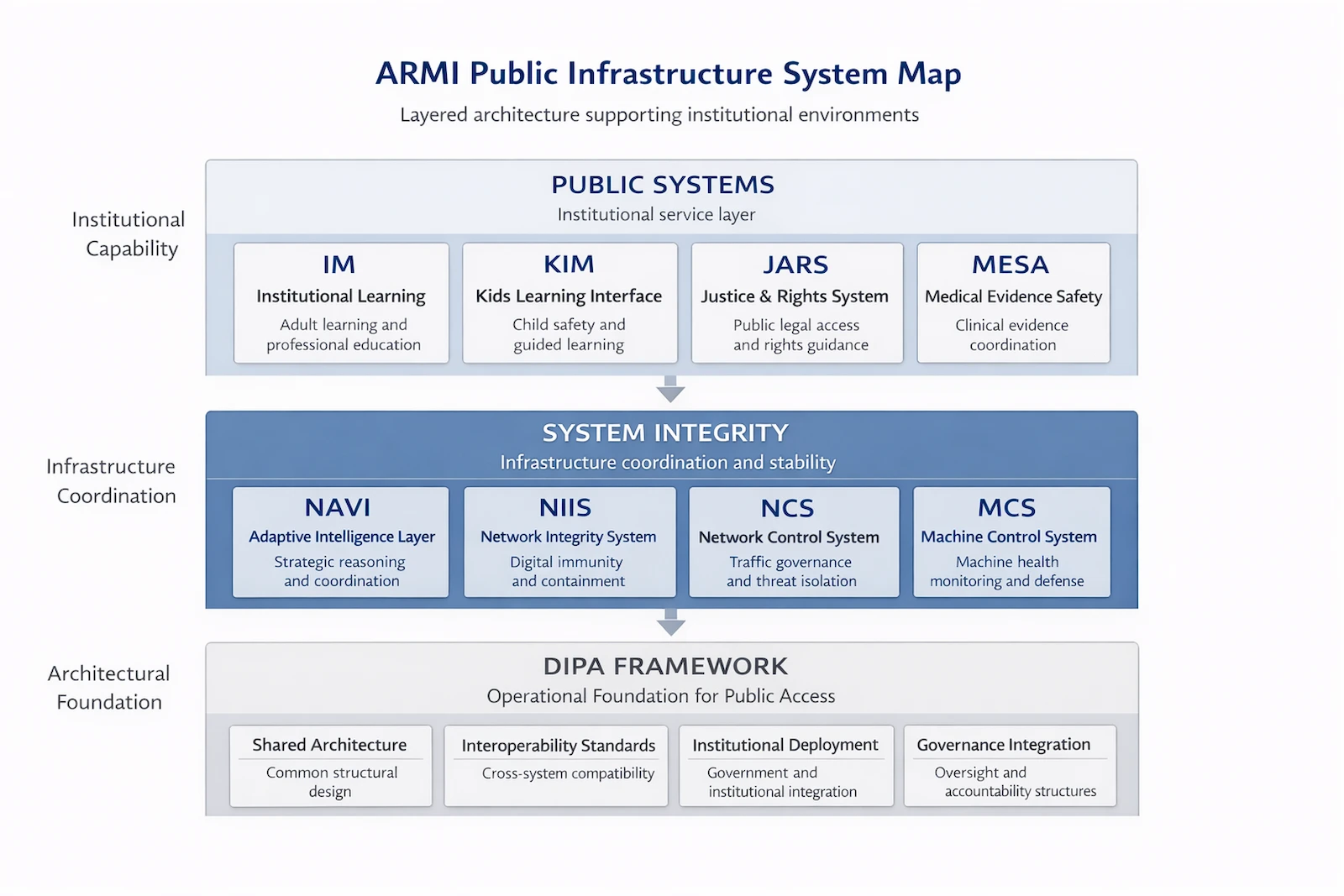
Public systems provide institutional capability across education, justice, and medical evidence safety. Beneath them, system integrity infrastructure maintains coordination, execution stability, and infrastructure reliability. The DIPA framework provides the architectural foundation that connects these layers.
View structural ecosystem architecture
Structural architecture of the public infrastructure ecosystem. Service systems operate at the institutional layer, supported by deeper intelligence and integrity infrastructure coordinated through the DIPA framework.
System Landscape
Public Systems & System Integrity
The systems below represent how this infrastructure takes form in practice. They are organized in three layers: Public Systems, System Integrity, and the Framework, together forming a connected environment across real world domains.
Public Systems
Public-facing systems designed for direct civic and institutional benefit.

Public Systems
An overview of education, justice, and health infrastructures designed for direct public and institutional benefit.
OVERVIEW →
MESA
Preventive medical evidence safety infrastructure designed to reduce harm caused by fragmented clinical and pharmaceutical information.
LEARN MORE →
JARS
State-aligned justice and rights system supporting legal access, procedural clarity, and civic understanding.
LEARN MORE →
Intelligent Master
Institutional learning intelligence supporting structured education, reasoning, and long-term knowledge alignment under human authority.
LEARN MORE →
Kids Intelligent Master
Child-first learning interface designed for curiosity, safety, and supervised educational environments.
LEARN MORE →System Integrity
The deeper layer that supports stability, coherence, and continuity across connected environments.

System Integrity
An architectural overview of the layers that preserve boundaries, authority separation, and long-term system governability.
OVERVIEW →
NAVI
Navigation and coordination layer supporting planning, supervision, and human oversight across systems.
LEARN MORE →
NIIS
Digital immunity and integrity system ensuring resilience, containment, and controlled infrastructure operation.
LEARN MORE →
NCS
Deterministic network control system supporting stability and coordinated operation.
LEARN MORE →
MCS
Deterministic machine execution control under explicit operational boundaries.
LEARN MORE →Framework
The structural and operational layer defining how the infrastructure is organized, connected, and sustained over time.

DIPA
The public digital infrastructure framework supporting education, justice, and long-term institutional continuity.
LEARN MORE →
Architecture
The canonical structure defining system layers, boundaries, authority separation, and execution governance.
LEARN MORE →
Ecosystem
An overview of system relationships and public-interest layers across the infrastructure landscape.
LEARN MORE →
ICI
The sole civic-facing interface layer coordinating access, presentation, and interaction under constitutional constraints.
LEARN MORE →
Governance
Institutional alignment structures that support clarity, review, and long-term continuity across how the infrastructure is applied and sustained.
LEARN MORE →Each of these systems operates within real institutional environments. Their structure reflects the conditions of the domains in which they are applied.
Application scope
Where this infrastructure operates
This infrastructure operates in real institutions, schools, courts, hospitals, public agencies, and service environments where people rely on systems every day. These are not experimental settings. They are environments shaped by regulation, professional responsibility, and budget limits.
In these contexts, complexity accumulates gradually: information is stored across platforms, procedures evolve over decades, and decisions must remain traceable long after they are made. The role of the infrastructure is practical, to help systems remain understandable, coordinated, and steady as they grow.
Institutional & civic domains
The infrastructure takes form within core areas of public life where continuity matters more than speed and clarity matters more than novelty.
Education
Schools and universities manage curriculum standards, assessment records, accreditation requirements, and long learning pathways. Over time, knowledge systems fragment across digital tools and administrative layers.
Systems such as IM and KIM operate within these environments to support structured learning, explanation, and continuity, helping educators and institutions maintain alignment without altering professional authority.
Justice
Courts and legal systems depend on procedures that must remain consistent, reviewable, and accessible. Documentation, case history, filings, and rights information often span multiple systems and jurisdictions.
JARS operates within this domain as a structured support layer, assisting orientation and procedural clarity while decisions remain fully within judicial and legal institutions.
Public health & medical safety
Hospitals and clinics coordinate laboratory data, imaging records, medication histories, and specialist input across separate platforms. Under time pressure, fragmented information can create risk.
MESA supports alignment of distributed medical evidence before decisions are made, preserving traceability and continuity without participating in diagnosis or treatment.
Public digital infrastructure
Administrative systems, public services, and civic platforms manage benefits, licensing, records, logistics, and service delivery at scale. As these systems expand, coordination across departments becomes increasingly complex.
Here, the infrastructure functions as a connective layer, supporting coherence across services while remaining embedded within existing institutional structures.
These institutional environments are not uniform. In some regions, the pressures described above become more visible, where gaps between public need and institutional capacity accumulate over time and across systems.
Operational environments
Where structural pressure becomes most visible
The structural conditions described earlier exist across many parts of the world, yet their visibility varies by region. In some environments, the gap between institutional capacity and public need becomes more pronounced as population growth, resource constraints, and system complexity accumulate over time.
These environments are not treated as isolated cases. Instead, they provide a clearer view of how structural pressures emerge when education systems, justice institutions, and public health infrastructures operate under sustained demand.
View environments where these conditions are most visible
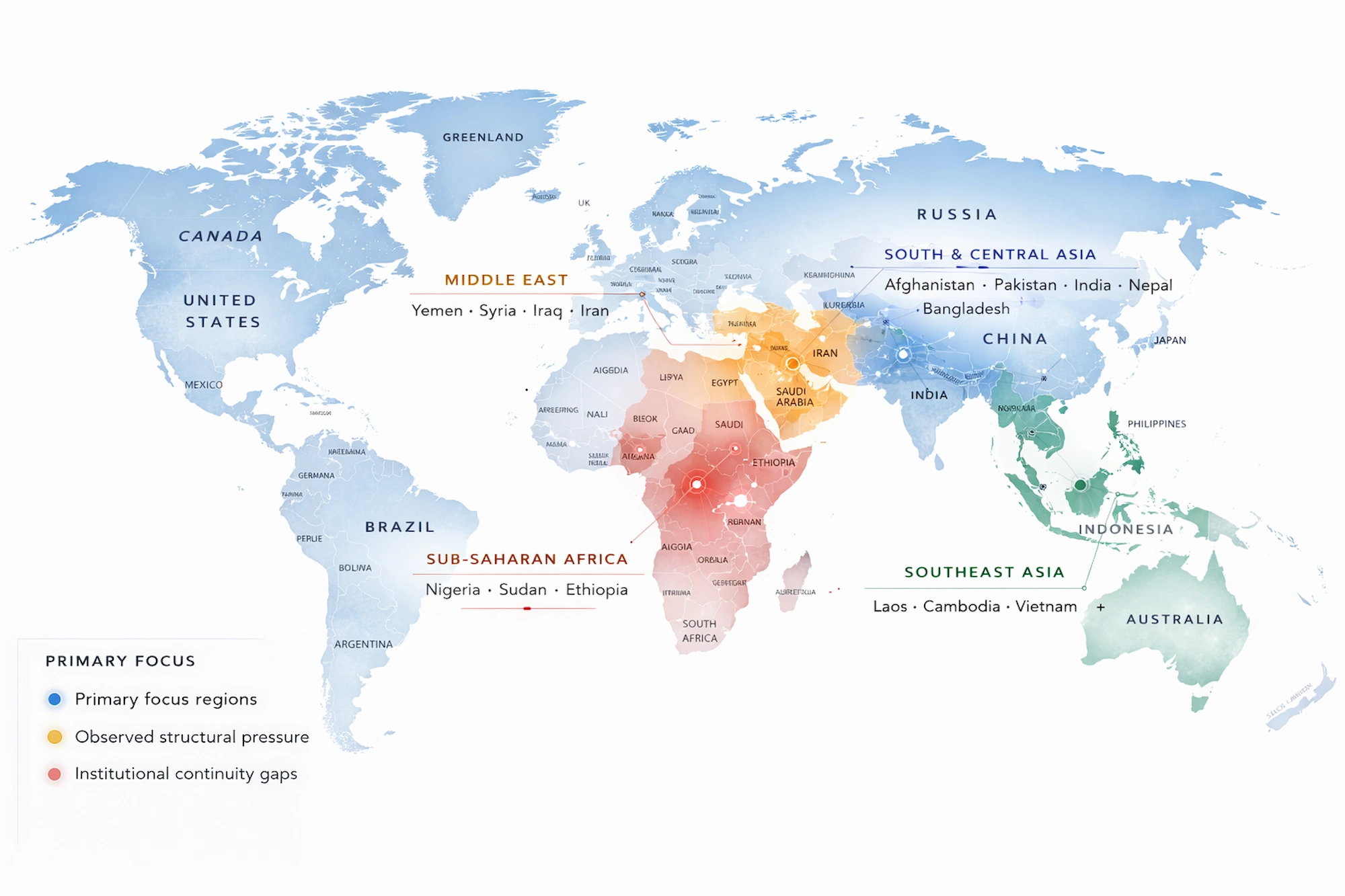
Structural pressure is not evenly distributed. Highlighted regions represent environments where challenges across education, justice, and public health systems converge more visibly.
South & Central Asia
Large and rapidly growing populations place sustained demand on education systems and institutional infrastructure. Countries including Afghanistan, Pakistan, India, Nepal, and Bangladesh illustrate how demographic scale can amplify challenges related to learning continuity, institutional capacity, and long-term system coordination. UNESCO – Global Education Monitoring
Middle East & conflict-affected environments
Prolonged instability in parts of the Middle East has affected the continuity of education systems, justice institutions, and public health coordination. Environments including Yemen, Syria, Iraq, and surrounding areas illustrate how institutional systems must operate under conditions of disruption while maintaining public services. UN SDG 16 – Justice access conditions
Sub-Saharan Africa
Rapid population growth and infrastructure constraints create persistent pressure across education continuity, justice access, and medical safety environments. Countries such as Nigeria, Sudan, Ethiopia, and neighboring regions illustrate how expanding populations interact with institutional resource limits and infrastructure development cycles. WHO – Medication Safety
Southeast Asia
In several Southeast Asian environments, progress in educational access and institutional development is visible, yet structural gaps remain between enrollment, system capacity, and long-term continuity. Countries including Laos and Cambodia illustrate how expanding access can outpace the institutional structures needed to sustain learning and public service systems. UNESCO – Regional learning analysis
Measurements such as the World Justice Project – Rule of Law Index provide additional visibility into structural conditions affecting legal access, procedural clarity, and institutional consistency across many jurisdictions worldwide.
These environments are not defined by deficiency. Instead, they provide clearer visibility into structural conditions that exist globally. They help reveal how institutional systems behave when operating under sustained demand, fragmentation, and long-term structural pressure.
In these contexts, the stability of underlying technical systems becomes increasingly important. As institutional pressure rises, the reliability of machine-scale infrastructure, coordination networks, and digital systems becomes directly connected to how public institutions function in practice.
Infrastructure execution
Machine-scale systems
in everyday operation
The institutions described above do not operate in isolation. In regions where institutional pressure increases, systems rely more heavily on underlying technical infrastructure. Networks, sensors, controllers, and automated systems operate continuously beneath public services, shaping how execution unfolds across environments.
In these environments, small inconsistencies can propagate quickly. Device fleets update asynchronously. Network logic evolves over time. Control systems operate beyond direct human visibility. Maintaining stable, interpretable behavior becomes a practical requirement rather than a theoretical one.
Execution environments
IoT & distributed device fleets
Schools, hospitals, utilities, and civic facilities deploy large numbers of connected devices, sensors, diagnostic tools, monitoring systems, and automated controls. These operate continuously and often outside centralized supervision.
The infrastructure supports execution models where device behavior remains structured and observable as scale increases.
Smart cities & civic coordination
Transportation routing, water systems, emergency logistics, and public safety coordination increasingly rely on machine-assisted control. These systems must adapt to real-world conditions without becoming opaque or unpredictable.
The infrastructure separates reasoning from execution layers so that coordination can expand while operational behavior remains consistent and reviewable.
Energy & critical infrastructure
Power grids and energy systems operate under safety-critical conditions, balancing load, responding to disturbances, and maintaining resilience across regions.
In these contexts, execution must remain stable across long lifecycles. The infrastructure supports structured separation between adaptive intelligence and deterministic control layers.
Buildings & industrial environments
Hospitals, campuses, logistics centers, and manufacturing facilities increasingly rely on embedded automation. Over time, layered upgrades can create operational opacity.
The infrastructure provides architectural boundaries that help systems remain interpretable and maintainable as technologies evolve.
Whether in classrooms, courtrooms, clinics, control rooms, or network operations centers, the requirement is consistent: systems must remain understandable to the institutions responsible for them. At both human and machine scale, the infrastructure exists to support steady, traceable operation across environments that cannot afford abstraction or instability.
With this broader execution context in view, public systems can be understood more clearly as the human-facing layer of a deeper infrastructure that extends from institutional practice into machine-scale operation.
Public systems in context
Public systems within
real institutional environments
Public systems operate inside established institutional cultures, schools shaped by curriculum standards, courts guided by procedural rules, and hospitals structured by clinical protocols and regulatory oversight. These environments evolve gradually and carry long histories of practice.
Systems such as IM (education), JARS (justice), and MESA (medical evidence safety) are introduced within these settings as support layers. They assist with explanation, coordination, and information alignment while remaining embedded in existing professional workflows.
In practice, this means working alongside teachers, legal professionals, clinicians, and administrators rather than redefining their roles. Decisions, interpretation, and responsibility continue to rest with the institutions and individuals already accountable for them.
Because institutional environments differ across regions, adoption occurs in ways that reflect local law, professional norms, and operational realities. The infrastructure adapts to context rather than imposing uniform structure.
Development draws from widely recognized guidance in education, justice, and health governance, not as branding or certification, but as reference points that inform how systems are shaped and reviewed over time.
Beneath these public-facing systems sits a technical integrity layer, described earlier, that supports coordination across platforms and environments. Together, these layers connect institutional practice with the underlying infrastructure on which modern public services depend.
These systems are not confined to conceptual design. They are beginning to take form through applied work, institutional engagement, and early-stage implementation.
Momentum
Infrastructure in motion
This work is no longer theoretical. What began as architectural research is now taking form through applied design, institutional dialogue, and early implementation across real environments.
Public systems are being refined, interfaces are tested within professional settings, and governance structures are examined alongside the institutions that would rely on them. Progress emerges through conversation, review, and practical use, not abstraction alone.
The ecosystem expands steadily. Research informs prototypes. Prototypes inform institutional feedback. Regional dialogue shapes adaptation. Each phase builds on the last, allowing the infrastructure to mature gradually and responsibly over time.
As this work progresses from design into application, the conditions for governance become central. Systems must remain aligned with institutional responsibility as they are introduced and expanded.
Governance & Integration
Governed integration within public institutions
Digital infrastructure for public access (DIPA) is structured for institutional and public environments where continuity, responsibility, and clarity must endure over time. Governance is not applied after deployment as an external policy layer; it is embedded directly into the architecture as a design condition. Roles, boundaries, and review pathways are defined structurally so authority remains visible and accountable.
Intelligence may assist analysis, coordination, and structured understanding, but decision-making authority remains fully human and institution-led. Technical capability is intentionally bounded so that responsibility does not diffuse in systems, agencies, or time. System behavior remains inspectable, explainable, and open to institutional oversight as it evolves.
This infrastructure operates alongside existing legal, professional, and civic systems. It is not positioned as a replacement framework, but as a stabilizing layer that strengthens clarity, access, and procedural coherence within established institutional roles. Adoption respects regional legal traditions, governance capacity, and cultural context while maintaining a consistent architectural foundation.
Deployment occurs through gradual integration. Systems may be introduced in limited scope, evaluated under review, and expanded where alignment and institutional readiness are present. They operate across applications, institutional platforms, and infrastructure-connected environments without requiring disruption of established workflows.
As contexts differ across regions and sectors, architectural behavior remains consistent. This allows environments to adopt and adapt systems over time while preserving operational clarity, long-term reliability, and public trust. The result is infrastructure designed for accountable continuity: complementary, reviewable, and sustained across generations.
Learn more about governance alignment →Knowledge & Reference
Publications & Indexes
Core documents and structured indexes provide a stable reference layer for understanding system design, long-term direction, and ongoing work.

ARMI Charter
Foundational document defining purpose, structure, and direction.

Strategic Vision 2026–2036
Long-horizon direction outlining system evolution and continuity.

Research
Exploration of systems, governance models, and long-term infrastructure thinking.
EXPLORE →
Whitepapers
Detailed documentation of architecture, frameworks, and system design.
EXPLORE →
News
Updates, milestones, and ongoing developments across the project.
EXPLORE →Open participation
Public Review & Input
This space is open to anyone who wants to explore, reflect, and share thoughts on the systems, ideas, and direction of this work.
Questions, observations, and perspectives are welcome from individuals and communities engaging with the broader role of public-interest infrastructure. Every input adds to a wider understanding shaped over time.
The focus is simple: thoughtful exchange, shared learning, and steady refinement through real engagement.
Closing note
Continuing forward
This work forms part of a public infrastructure, designed to remain steady, predictable, and present across time.
You’re invited to move through it in your own way, whether exploring systems, engaging in dialogue, or contributing to its continued development.